

LITTLE ITALY / NOLITA
Manhattan
Geographic Setting
Nestled in Lower Manhattan between Canal Street and Houston Street, and stretching from Bowery west to Lafayette Street, Little Italy and NoLIta (North of Little Italy) form adjoining districts that together chart one of New York’s most poignant urban evolutions. Little Italy remains a cherished fragment of the city’s immigrant past — a corridor of cafés, bakeries, and red-brick tenements echoing with memory — while NoLIta has emerged as a creative enclave of boutiques, design studios, and modern eateries. The two are inseparable halves of the same story: the passage from old-world tradition to 21st-century reinvention, all within a few winding blocks of cobblestone and history.
Etymology and Origins
The name Little Italy entered common use in the late 19th century, when waves of immigrants from southern Italy — especially Sicily, Naples, and Calabria — began settling in the narrow streets just north of Mulberry Bend. For decades, it was both a literal and symbolic homeland for Italians arriving through Castle Garden and Ellis Island. The newer designation NoLIta — short for “North of Little Italy” — emerged in the 1990s as the area north of Kenmare Street transitioned from working-class enclave to fashionable residential and commercial district. Together, the names trace the neighborhood’s transformation from an ethnic stronghold to a crossroads of global urban life.
The Neighborhood
19th Century: The Immigrant Quarter
By the mid-1800s, this section of Manhattan had already seen successive waves of settlement — first Irish, then German — as immigrants crowded into tenement housing near the Lower East Side. When Italian families began arriving in large numbers in the 1880s and 1890s, they found a district already dense and chaotic, but rich with opportunity. Mulberry Street, with its tenements and pushcarts, became the epicenter of Italian-American life.
Life here was tough but vibrant. Narrow alleys like Hester, Grand, and Broome Streets bustled with vendors selling fruit, bread, and pasta; children played under laundry lines strung between buildings; church bells rang from Most Precious Blood Church and Old St. Patrick’s Cathedral on Mulberry and Prince Streets. Extended families crowded into walk-up flats where Italian remained the language of daily life.
The community’s structure was both intimate and hierarchical. Each block often reflected a specific town or province from Italy — Sicilians here, Neapolitans there — preserving dialects and customs across the ocean. Fraternal societies, mutual-aid clubs, and small groceries sustained a culture of solidarity amid poverty.
Early 20th Century: Tradition and Transition
By 1900, Little Italy was among the densest neighborhoods in the Western world. Tenement reformers like Jacob Riis photographed its crowded conditions, while journalists romanticized its color and energy. Despite hardship, the neighborhood thrived as a cultural enclave.
The Feast of San Gennaro, first celebrated in 1926, became both religious festival and communal assertion — a pageant of faith, food, and pride that continues today. Bakeries such as Ferrara’s (founded 1892) and restaurants like Lombardi’s, America’s first pizzeria (1905), became local institutions and symbols of endurance.
Yet as the first generation prospered, the second began moving out. By the 1920s and 1930s, many Italian-American families relocated to the Bronx, Brooklyn, and Queens, seeking better housing and open space. The population decline accelerated after World War II, leaving behind aging residents, storefronts, and memories.
Mid-20th Century: Decline, Resilience, and Reinvention
By the mid-20th century, Little Italy had contracted dramatically. The construction of nearby expressways and the expansion of Chinatown reshaped its borders. What remained — a few blocks around Mulberry, Grand, and Hester Streets — survived largely through its restaurants, bakeries, and the enduring magnetism of the Feast of San Gennaro.
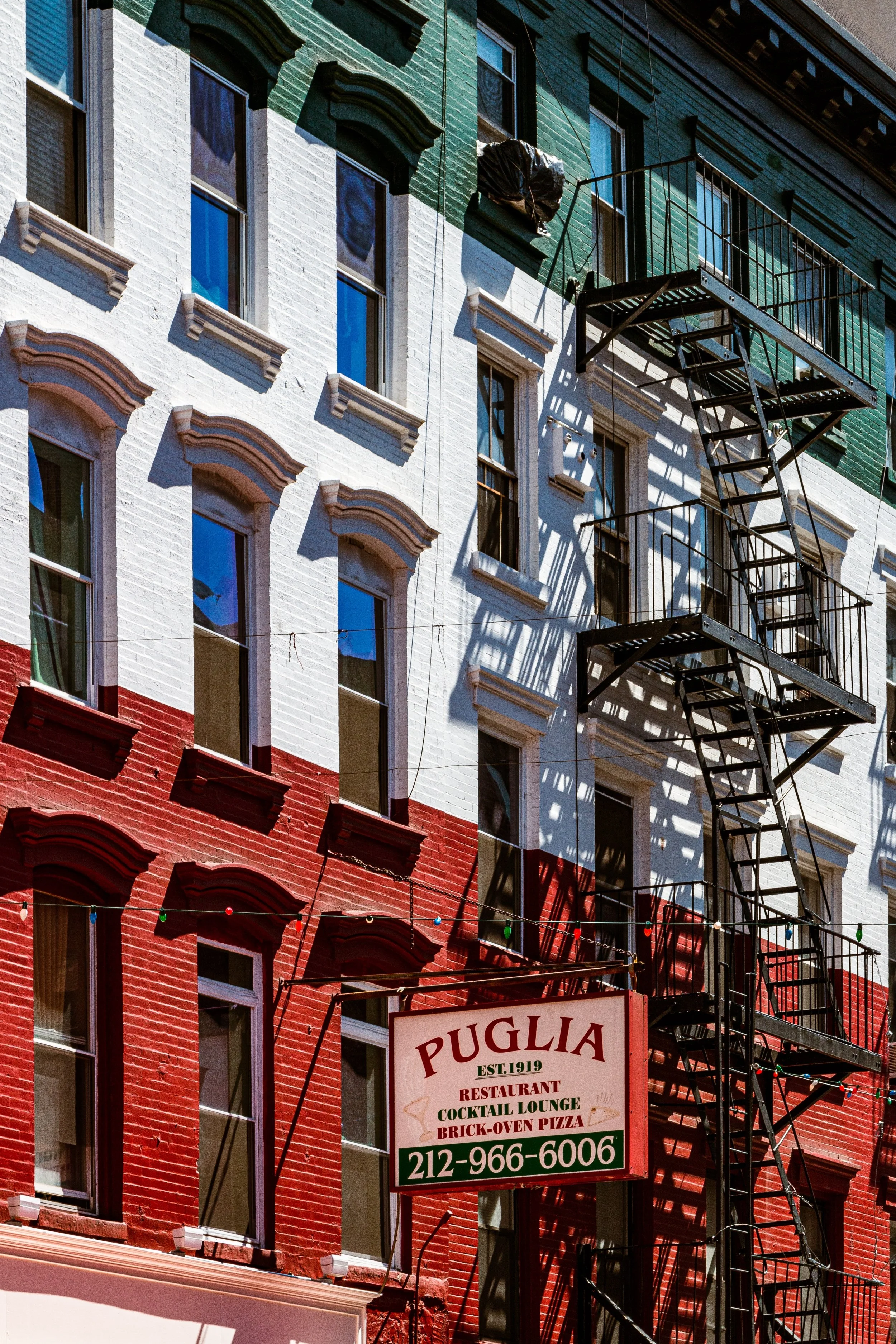
Meanwhile, north of Kenmare Street, the area now called NoLIta remained a working-class district of tenements and light industry. Small factories, printing shops, and garages filled the loft buildings along Elizabeth and Mott Streets. The neighborhood’s Italian character persisted in fragments — social clubs, parish halls, and corner cafés where elderly men still played cards beneath fading tricolor flags.
During the 1970s and 1980s, as SoHo and the East Village became havens for artists, NoLIta began attracting creative pioneers seeking inexpensive space. Photographers, designers, and filmmakers found inspiration in its cobbled streets and vintage architecture. The stage was set for the neighborhood’s next act.
Little Italy / NoLIta Photographic Tour
Late 20th Century: The Birth of NoLIta
By the 1990s, real estate agents and local entrepreneurs coined the name NoLIta to capture the district’s growing appeal as a boutique and residential hub “north of Little Italy.” Former tenements and factories were converted into airy lofts; cafés, fashion houses, and design studios replaced hardware stores and garages.
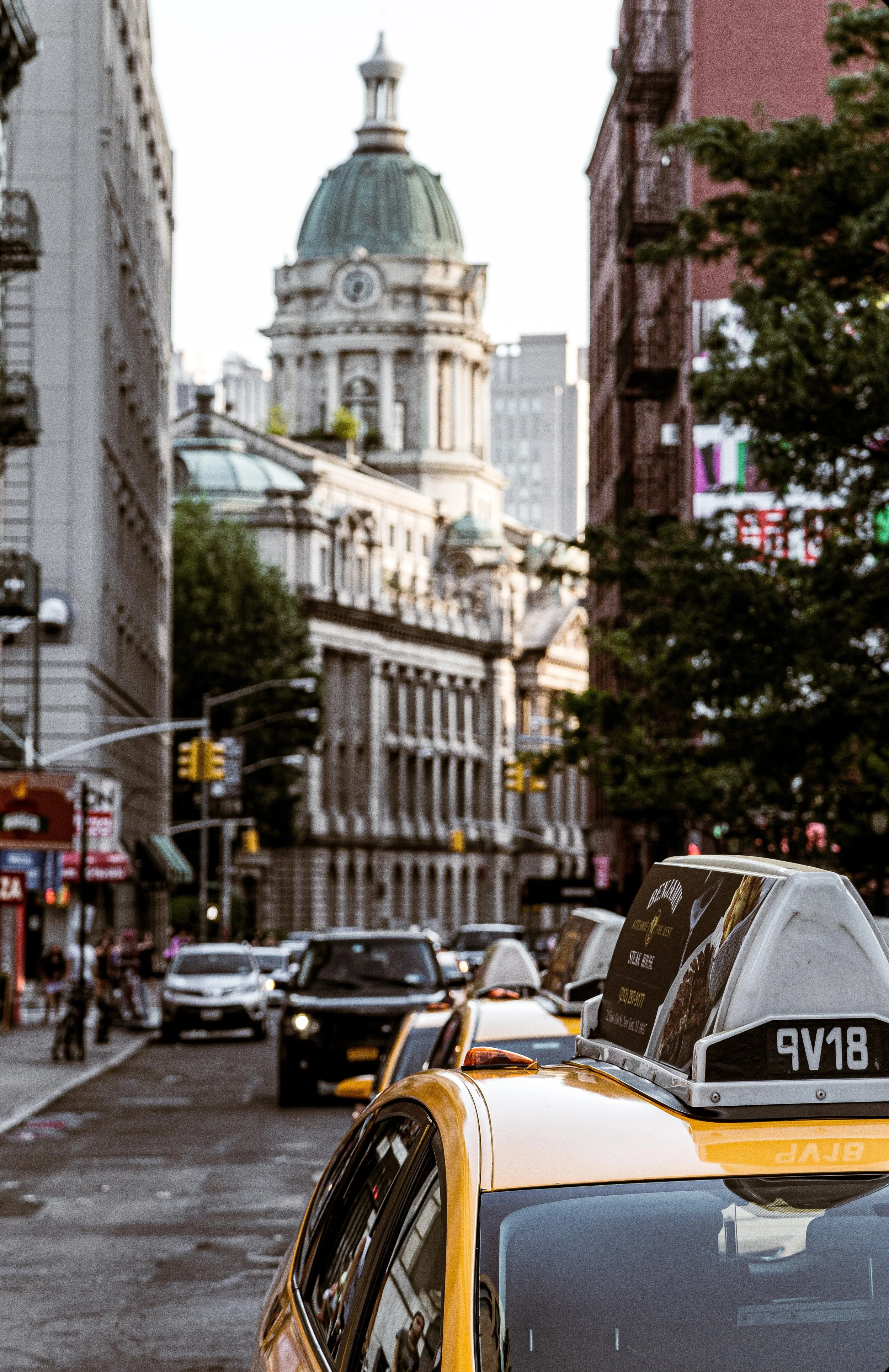
Yet the juxtaposition of old and new remained striking. Mulberry Street below Kenmare retained its red-checkered restaurants and outdoor dining; above it, minimalism and modernity reigned. The Old St. Patrick’s Cathedral, completed in 1815 and serving as the seat of New York’s first Catholic diocese, became the symbolic bridge between eras — a monument of faith amid changing streets.
21st Century: Heritage and Modernity Intertwined
Today, Little Italy and NoLIta coexist as complementary worlds. The former, though smaller, remains a touchstone of nostalgia — a living postcard that honors its immigrant founders. Its restaurants, some family-run for generations, continue to serve traditional dishes under strings of lights and Italian flags. The Feast of San Gennaro each September still transforms Mulberry Street into a sea of color, aroma, and memory, drawing both descendants and visitors from around the world.
NoLIta, by contrast, embodies the city’s creative reinvention. Its boutique-lined streets — Elizabeth, Mott, and Prince — house independent designers, galleries, and cafés, many occupying preserved 19th-century buildings. The district’s human scale and historic charm have made it one of downtown Manhattan’s most sought-after residential enclaves.
In recent years, the neighborhood has also seen a wave of culinary innovation: Italian traditions blending with global influences in modern trattorias and espresso bars. This fusion mirrors the area’s broader identity — rooted in heritage, but ever-evolving.
Little Italy / NoLIta Photo Gallery
Architecture and Atmosphere
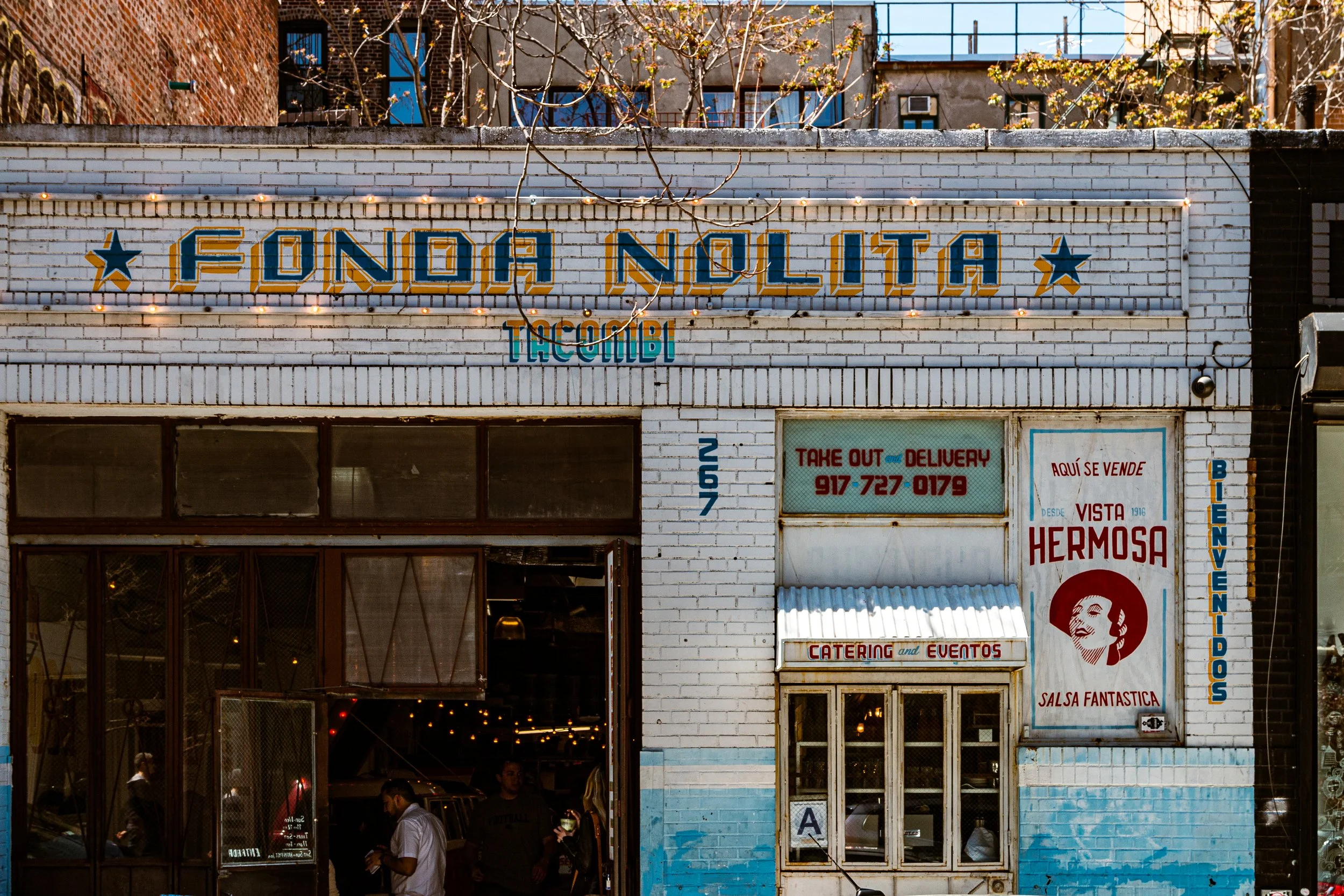
Architecturally, Little Italy and NoLIta are defined by their intimacy. Narrow streets, low-rise brick façades, cast-iron cornices, and fire escapes create a textured streetscape reminiscent of old New York. Tenements from the 1880s stand beside former manufacturing lofts, their façades adorned with faded painted signs. The Hester Street Market and Elizabeth Street Garden provide rare pockets of open air amid the density.
The atmosphere is both cinematic and sensory. In Little Italy, the air carries the scent of espresso, garlic, and roasting chestnuts; waiters call out greetings in half-remembered Italian; tourists and locals alike linger beneath neon signs that once symbolized arrival. In NoLIta, mornings hum with quiet refinement — bicycles gliding past boutique windows, conversations over cappuccino spilling onto sidewalks lined with cast-iron facades. Together, they form a continuum: the old village and the new atelier, the past and future entwined.
Spirit and Legacy
The legacy of Little Italy and NoLIta is endurance through transformation. They tell the story of immigration and imagination — how the city’s humblest beginnings became the foundation of its cosmopolitan spirit. Little Italy preserves the memory of struggle and solidarity; NoLIta embodies the creative reinvention that defines modern New York.
New York City
Use this custom Google map to explore where every neighborhood in all five boroughs of New York City is located.
The Five Boroughs
One of New York City’s unique qualities is its organization in to 5 boroughs: Manhattan, Brooklyn, Queens, The Bronx, and Staten Island. These boroughs are part pragmatic administrative districts, and part vestiges of the region’s past. Each borough is an entire county in New York State - in fact, Brooklyn is, officially, Kings County, while Staten Island is, officially Richmond County. But that’s not the whole story …
Initially, New York City was located on the southern tip of Manhattan (now the Financial District) that was once the Dutch colony of New Amsterdam. Across the East River, another city was rising: Brooklyn. In time, the city planners realized that unification between the rapidly rising cities would create commercial and industrial opportunities - through streamlined administration of the region.
So powerful was the pull of unification between New York and Brooklyn that three more counties were pulled into the unification: The Bronx, Queens, and Staten Island. And on January 1, 1898, the City of New York unified two cities and three counties into one Greater City of New York - containing the five boroughs we know today.
But because each borough developed differently and distinctly until unification, their neighborhoods likewise uniquely developed. Today, there are nearly 390 neighborhoods, each with their own histories, cultures, cuisines, and personalities - and each with residents who are fiercely proud of their corner of The Big Apple.