
Geographic Setting
Bounded by East 14th Street to the south and East 23rd Street to the north, and stretching from First Avenue eastward to the East River, Stuyvesant Town and Peter Cooper Village together form one of Manhattan’s most distinctive planned residential communities. These twin developments occupy a vast 80-acre expanse on Manhattan’s East Side—land once crowded with tenements, factories, and docks—now transformed into a carefully landscaped campus of red-brick towers, lawns, and tree-lined paths.
To the south lies Stuyvesant Town, the larger of the two, its circular central oval marking one of New York’s most recognizable pieces of postwar urban design. To the north stands Peter Cooper Village, slightly older and built on higher ground, with broader lawns and fewer, taller buildings. The entire complex is ringed by major cross streets—14th Street, 20th Street, and 23rd Street—and bordered on its western edge by the steady flow of First Avenue traffic, while to the east, the FDR Drive and the East River Park Esplanade form its natural and infrastructural boundary. The result is an enclave of calm geometry within the city’s grid—a self-contained neighborhood where order, greenery, and community define the urban experience.
Etymology and Origins
The name “Stuyvesant Town” honors Peter Stuyvesant, the last Dutch Director-General of New Netherland, whose 17th-century estate encompassed much of the East Side below 23rd Street. Peter Cooper Village, directly north, commemorates Peter Cooper (1791–1883), inventor, philanthropist, and founder of Cooper Union, whose ideals of civic progress and education resonated with the postwar era’s vision of modern community building.
Before the construction of these developments, this area was known as the Gas House District, a gritty industrial neighborhood dominated by hulking gas storage tanks, slaughterhouses, and overcrowded tenements. Its proximity to the East River made it convenient for industry but hazardous and unsanitary for residents. By the early 1940s, city leaders, spurred by reformist zeal and federal urban renewal programs, targeted the area for redevelopment. The project that followed would reshape not only the physical landscape, but also the social architecture of postwar New York.
The Neighborhood
Mid-20th Century: Conception, Clearance, and Construction
The genesis of Stuyvesant Town–Peter Cooper Village belongs to the era of public–private partnership in postwar housing. In 1943, New York City entered an agreement with Metropolitan Life Insurance Company to build a large-scale residential community that would address the housing shortage for returning veterans and middle-income families. Under the enabling legislation of the Redevelopment Companies Act of 1942, MetLife was granted eminent domain powers and tax exemptions in exchange for maintaining long-term affordability.
The project was controversial from the outset. More than 11,000 residents of the old Gas House District—many of them working-class immigrants—were displaced, and the exclusion of Black families from tenancy until 1949 drew national condemnation and landmark civil rights litigation. Nevertheless, the development went forward, hailed as a triumph of modern planning.
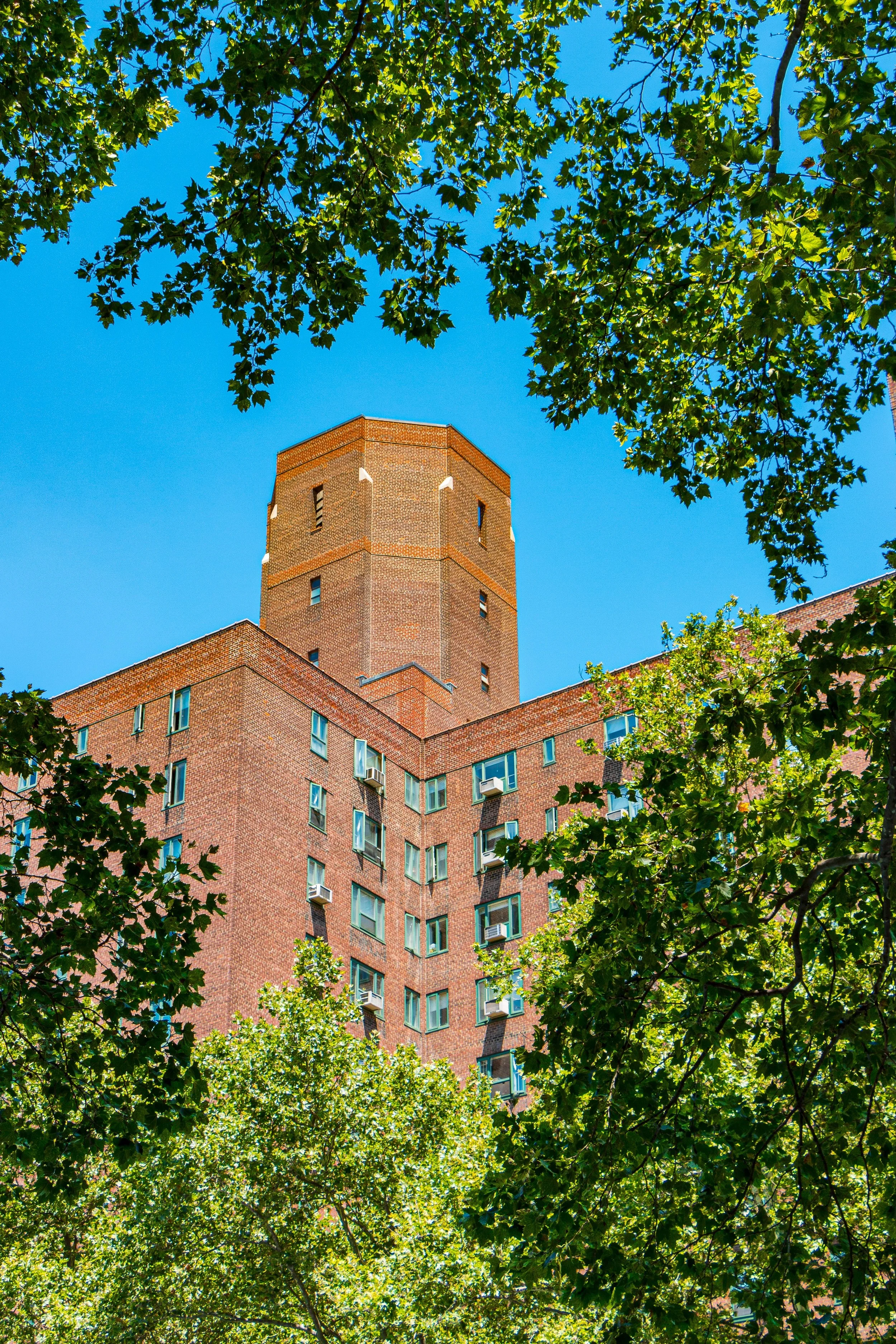
Stuyvesant Town, designed by architects Irwin Clavan, William Lescaze, and Emery Roth & Sons, opened in 1947. Its 35 buildings, arranged in superblocks around landscaped courtyards, introduced a new urban typology—neither high-rise nor tenement, but a “garden city” for the middle class. Peter Cooper Village, completed in 1949, offered slightly larger apartments and broader lawns, intended for higher-income tenants. Together, the two developments comprised 110 buildings, 11,250 apartments, and a population exceeding 25,000—a “city within a city.”
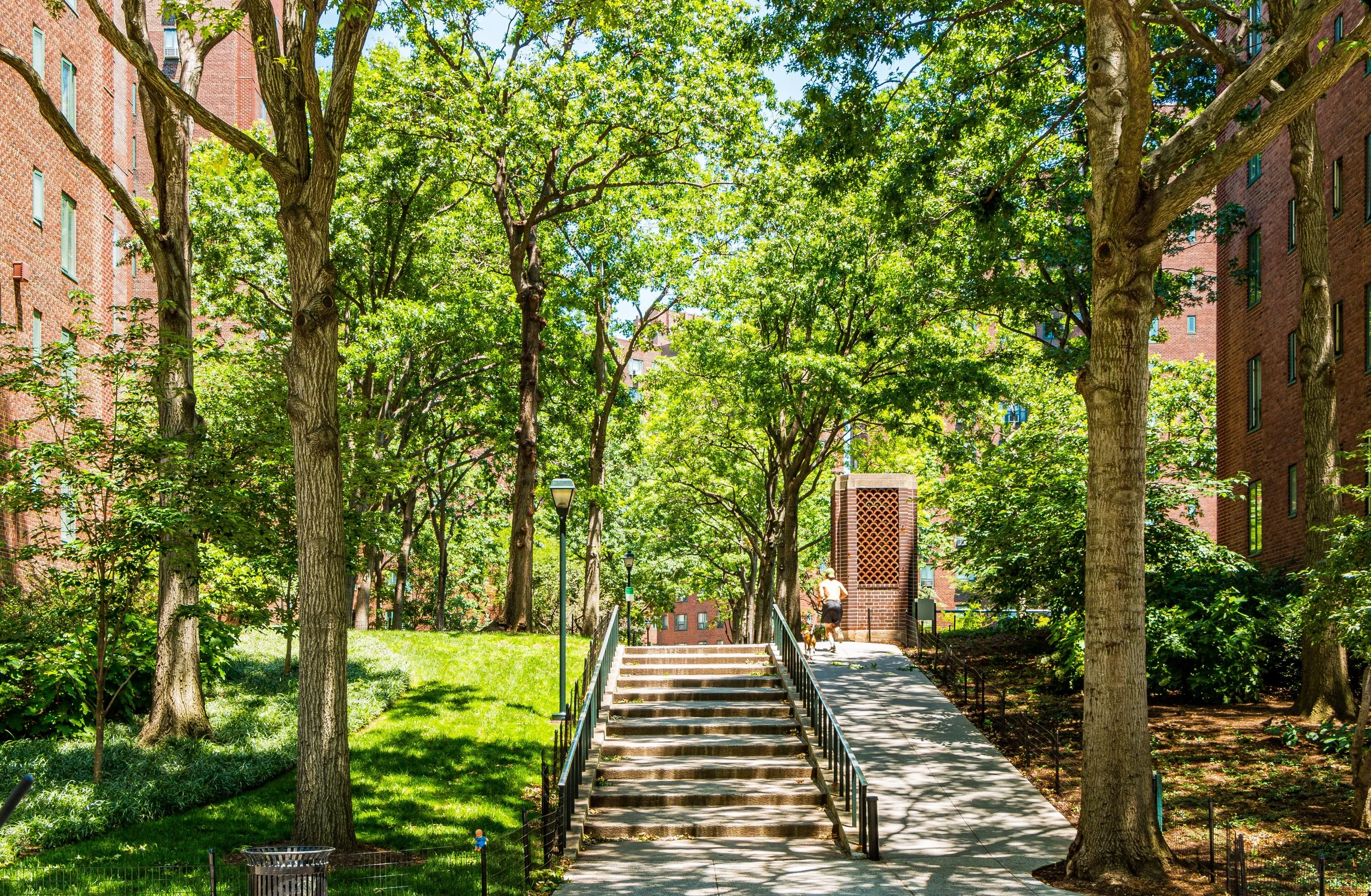
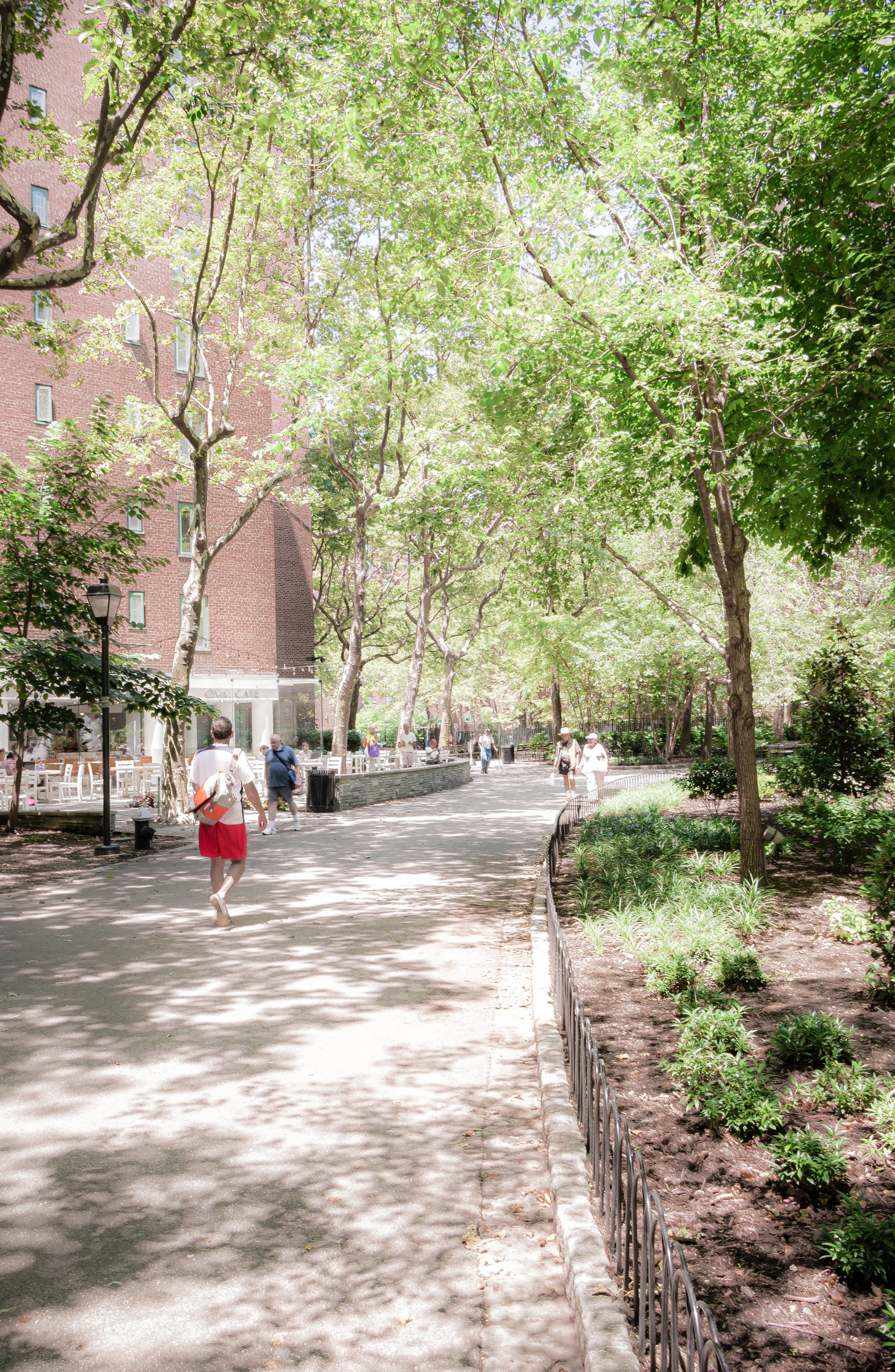
The architectural language was modernist yet humane: red-brick towers set amid green lawns, tree-lined walkways, playgrounds, and fountains. Cars were relegated to peripheral roads; the interior remained pedestrian and park-like. For generations of New Yorkers, these design choices defined the meaning of livable urban modernity.
1950s–1970s: A Middle-Class Ideal
For three decades after its completion, Stuyvesant Town–Peter Cooper Village epitomized the postwar middle-class dream—affordable rents, manicured lawns, and a sense of safety in the heart of Manhattan. Residents were clerks, teachers, civil servants, and young families; their children played in the ovals, attended the complex’s own schools, and walked safely to nearby PS 40 and Stuyvesant Square Park.
Community life flourished under the careful management of Metropolitan Life. Tenants organized events, sports leagues, and block associations; lawns were pristine, and social order was quietly maintained. The developments were neither luxurious nor ostentatious, but solid, egalitarian, and family-oriented. In a city marked by housing scarcity and urban unrest, Stuyvesant Town–Peter Cooper Village stood as a model of stability.
Yet beneath this serenity, tensions simmered over issues of equity and control. Rent stabilization, racial integration, and questions of corporate influence on civic life shaped the neighborhood’s politics. The 1949 court ruling that forced MetLife to end racial discrimination in tenant selection marked one of New York’s early civil rights victories, even as it underscored the project’s complex social legacy.
Manhattan Neighborhoods Photographic Tour
Late 20th Century: Privatization and Preservation Battles
By the 1980s, New York’s housing landscape was shifting. Inflation, deregulation, and corporate divestment pressures led MetLife to explore selling the complex. In 2001, the company officially divested, and in 2006, the Blackstone Group and Tishman Speyer acquired Stuyvesant Town–Peter Cooper Village for a record $5.4 billion—the largest real estate transaction in U.S. history at that time. The deal was emblematic of Wall Street’s speculative era: plans to deregulate rents and convert units to luxury apartments ran aground during the 2008 financial crisis, leaving investors bankrupt and tenants mobilized.
Residents, organized under the Stuyvesant Town–Peter Cooper Village Tenants Association, fought fiercely to preserve affordability. Their efforts—supported by city and state officials—culminated in the 2015 acquisition by Blackstone and Ivanhoé Cambridge, which committed to maintaining 5,000 rent-regulated apartments for twenty years. This agreement marked a rare triumph for tenants’ rights in modern New York.
Despite ownership changes, the physical and social character of the neighborhood endured. The ovals, playgrounds, and red-brick façades remained as they had for generations, maintained through continuous reinvestment and community vigilance.
21st Century: Community, Continuity, and Quiet Modernization
In the 21st century, Stuyvesant Town and Peter Cooper Village remain havens of calm within Manhattan’s frenetic grid. Extensive landscape restorations have refreshed the ovals and playgrounds, while infrastructure upgrades—green roofs, solar panels, and stormwater management systems—reflect a new era of environmental consciousness. Stuyvesant Cove Park, along the East River, provides waterfront access and connects the complex to the East River Greenway and Ferry Landing.
Demographically, the area remains mixed: a blend of long-term rent-stabilized residents, new professionals, and families attracted by the greenery, proximity to Midtown, and strong schools. The neighborhood’s pedestrian paths, tree-lined lawns, and absence of through traffic continue to evoke a rare tranquility. In many ways, Stuyvesant Town and Peter Cooper Village stand as a successful mid-century compromise between urban density and suburban ideals—a design vision still relevant in the age of megatowers.
Stuyvesant Town Photo Gallery
Spirit and Legacy
Stuyvesant Town and Peter Cooper Village embody the postwar promise of planned urban community—a belief that design and policy together could create fairness, comfort, and beauty in the modern city. Though born of displacement and controversy, the developments matured into one of Manhattan’s most enduring neighborhoods, where tens of thousands have lived lives defined by safety, stability, and community.
Their lawns and brick façades are not monuments to modernism’s austerity, but to its optimism—a conviction that city life could be humane, ordered, and green. At twilight, when the lights of the oval fountain shimmer and the East River reflects the glow of Midtown’s towers, Stuyvesant Town and Peter Cooper Village remind New York of its postwar faith in collective progress: the enduring dream of a better city, built for all.
New York City
Use this custom Google map to explore where every neighborhood in all five boroughs of New York City is located.
The Five Boroughs
One of New York City’s unique qualities is its organization in to 5 boroughs: Manhattan, Brooklyn, Queens, The Bronx, and Staten Island. These boroughs are part pragmatic administrative districts, and part vestiges of the region’s past. Each borough is an entire county in New York State - in fact, Brooklyn is, officially, Kings County, while Staten Island is, officially Richmond County. But that’s not the whole story …
Initially, New York City was located on the southern tip of Manhattan (now the Financial District) that was once the Dutch colony of New Amsterdam. Across the East River, another city was rising: Brooklyn. In time, the city planners realized that unification between the rapidly rising cities would create commercial and industrial opportunities - through streamlined administration of the region.
So powerful was the pull of unification between New York and Brooklyn that three more counties were pulled into the unification: The Bronx, Queens, and Staten Island. And on January 1, 1898, the City of New York unified two cities and three counties into one Greater City of New York - containing the five boroughs we know today.
But because each borough developed differently and distinctly until unification, their neighborhoods likewise uniquely developed. Today, there are nearly 390 neighborhoods, each with their own histories, cultures, cuisines, and personalities - and each with residents who are fiercely proud of their corner of The Big Apple.