
GREENWICH VILLAGE
Manhattan
Geographic Setting
Greenwich Village—universally known simply as the Village—lies on Manhattan’s west side between Houston Street to the south and 14th Street to the north, bounded by Sixth Avenue on the west and by Mercer Street (from Houston to East 8th Street) and Fourth Avenue (from 8th to 14th) on the east. This irregular wedge of land—set apart from the rectilinear grid imposed on Manhattan in 1811—retains its 18th-century street pattern of angled, winding lanes. Within these eccentric bounds, tree-lined blocks, historic rowhouses, and small squares evoke the pre-industrial city more vividly than anywhere else in Manhattan.
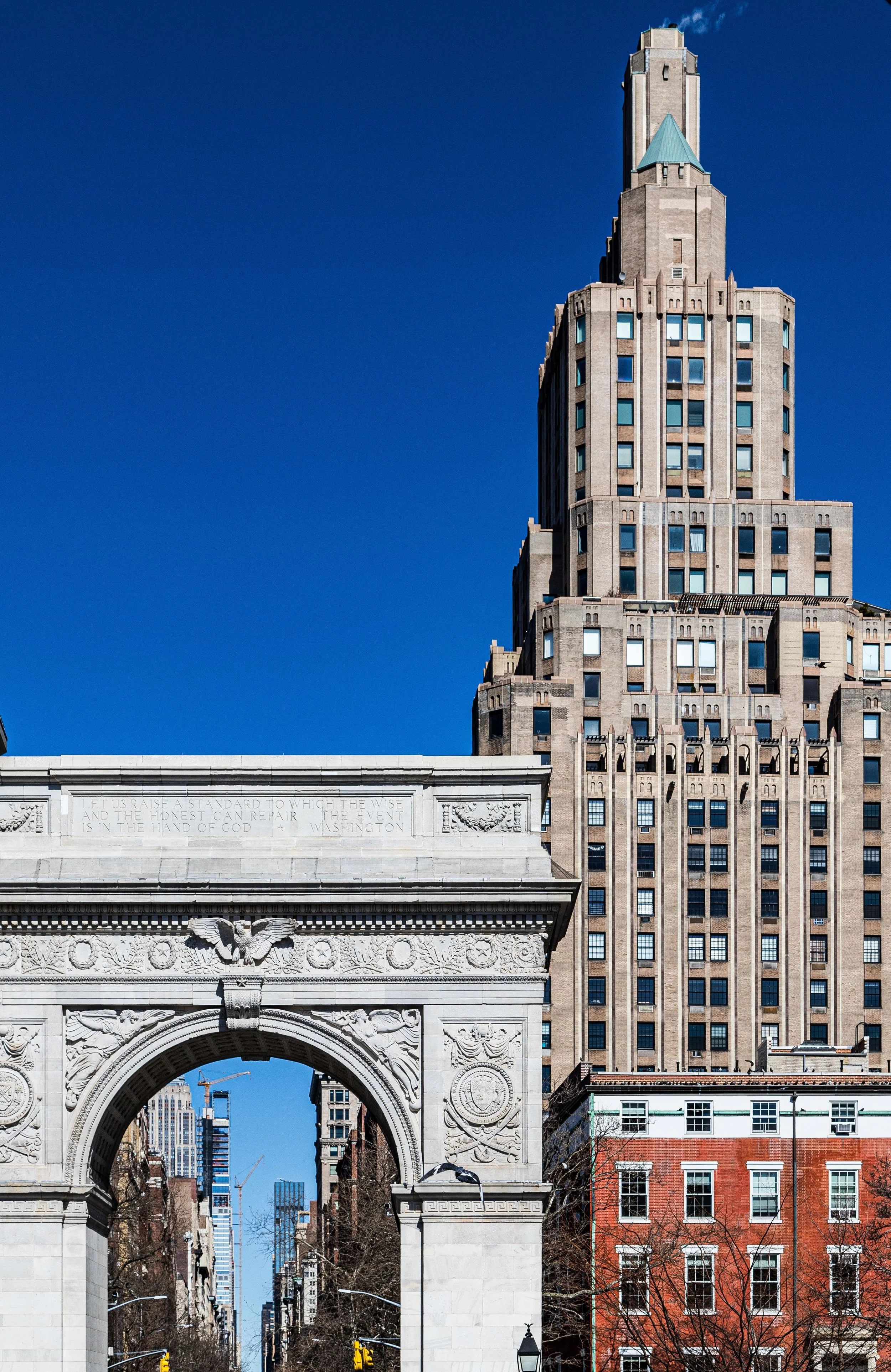
To the north, the Jefferson Market Library’s clock tower presides over the crossroads of Sixth Avenue and 10th Street like a Gothic sentinel. To the south, Houston Street forms a hard edge separating the Village from SoHo. Within, narrow lanes—Bleecker, MacDougal, Waverly Place, Perry, and Gay Street—converge around Washington Square Park, the neighborhood’s social and symbolic heart.
Etymology and Origins
The name “Greenwich” derives from the Dutch term Greenwijck, or “Green District,” used in the 1600s to describe this small riverside settlement north of New Amsterdam. In the 17th and early 18th centuries, the area was pastoral—a patchwork of farms, orchards, and estates that provided refuge from the crowded southern tip of Manhattan. One of the largest estates belonged to Sir Peter Warren, a British naval officer, whose holdings extended across much of today’s West Village and lent their name to Warren Place and Warren Street.
In the 1790s, a yellow fever epidemic drove many New Yorkers northward to the “healthy air” of Greenwich, transforming it from countryside to village. The district’s relative isolation spared it from the 1811 Commissioners’ Plan, which imposed Manhattan’s rectilinear grid above Houston Street. Thus the Village retained its colonial street pattern—angled roads like West 4th Street, which famously crosses West 10th, surviving as picturesque anomalies within an otherwise orthogonal city.
The Neighborhood
19th Century: From Suburban Hamlet to Urban Village
By the 1820s–1840s, Greenwich Village had become a desirable residential district for prosperous New Yorkers. Elegant Federal and Greek Revival rowhouses lined Washington Square North, Waverly Place, and West 10th Street. The creation of Washington Square Park (1826)—converted from a former potter’s field—anchored the neighborhood’s civic and social life. Around its perimeter, institutions such as New York University (founded 1831) and the Judson Memorial Church (1892) established a tradition of intellectual and reformist energy that continues to define the area.
During the mid-19th century, waves of immigration diversified the Village’s character. Irish, Italian, and later Eastern European communities settled in the narrower streets to the south and east, forming tight-knit enclaves that coexisted with the more affluent squares. Craft trades flourished, and the neighborhood became known for its small workshops, taverns, and boardinghouses. Its compact, irregular streets fostered a sense of community rare in the growing metropolis.
Early 20th Century: Bohemia and Rebellion
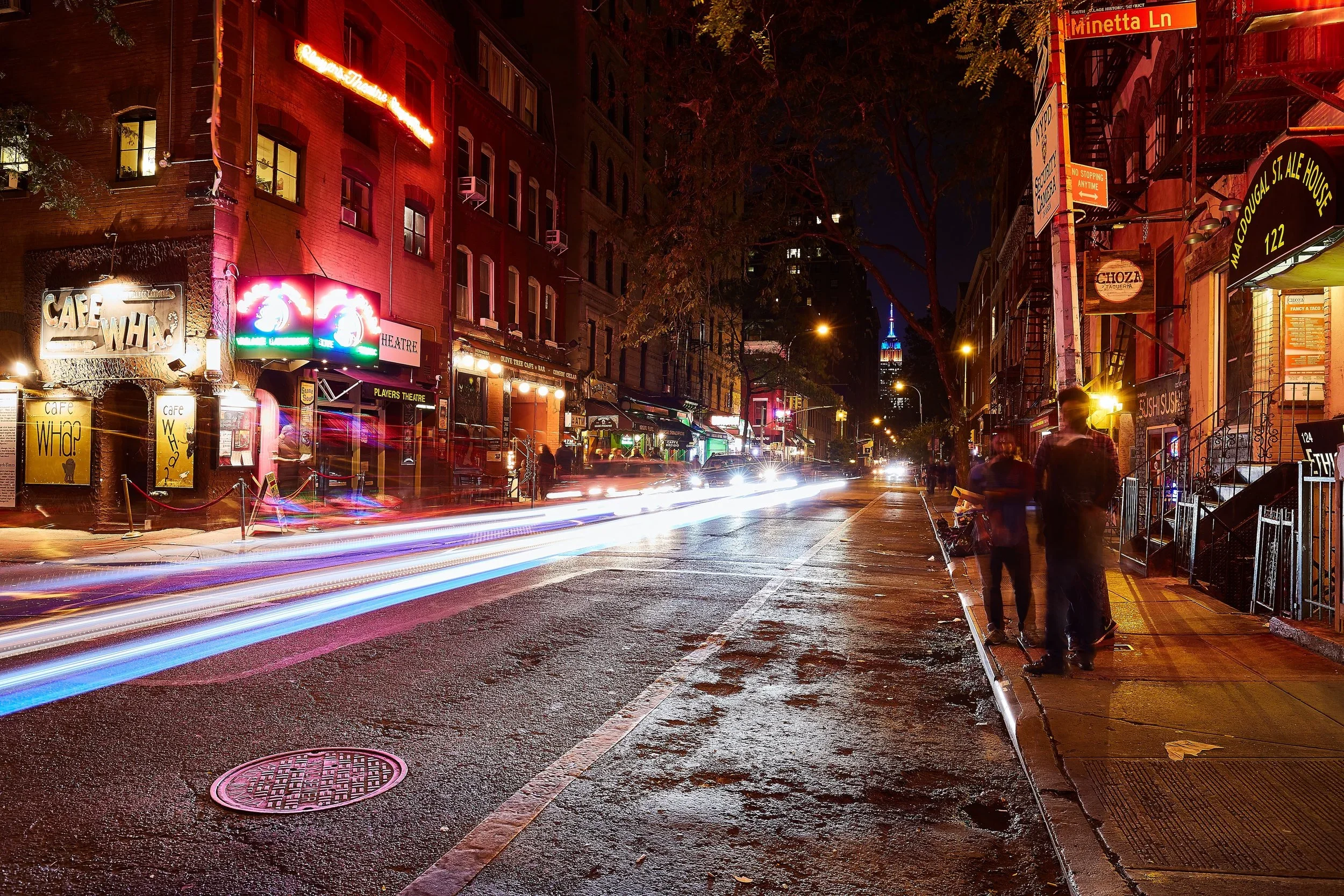
By the early 1900s, Greenwich Village had become a magnet for writers, artists, reformers, and political radicals. Its affordable rents, proximity to the city’s publishing world, and labyrinthine geography fostered both creativity and independence. Cafés along MacDougal Street and Washington Square South became gathering places for modernists and freethinkers. Figures such as Edna St. Vincent Millay, Eugene O’Neill, John Sloan, and Isadora Duncan lived and worked here, while the Provincetown Playhouse introduced groundbreaking theater.
The Village’s narrow streets and modest scale nurtured an anti-establishment spirit. In the 1910s–1920s, suffragists, socialists, and anarchists—including Emma Goldman and members of the Industrial Workers of the World—used its coffeehouses and meeting halls as headquarters. The Greenwich Village bohemians of this era defined a new American cultural archetype: romantic, liberal, and defiantly unconventional. Their ethos laid the groundwork for every countercultural movement that followed.
Mid-20th Century: Jazz, Beats, and Preservation Battles
In the 1940s–1950s, Greenwich Village became synonymous with jazz and the Beat Generation. Clubs like the Village Vanguard, Café Society, and Five Spot hosted legends such as Thelonious Monk, Billie Holiday, and Miles Davis. Meanwhile, poets and writers—Allen Ginsberg, Jack Kerouac, Diane di Prima—transformed coffeehouses into stages of literary rebellion. The neighborhood’s mixture of students, artists, and working-class residents created a social microcosm of postwar New York: restless, idealistic, and diverse.
Yet the Village’s human scale came under threat during the city’s urban renewal era. Robert Moses’s plans for a Lower Manhattan Expressway and a widened Fifth Avenue posed existential dangers. Led by activist Jane Jacobs, Villagers organized one of the most influential preservation movements in American history. Their victory in the 1950s–1960s not only saved the neighborhood but reshaped urban planning nationwide—prioritizing community, livability, and local character over grandiose infrastructure.
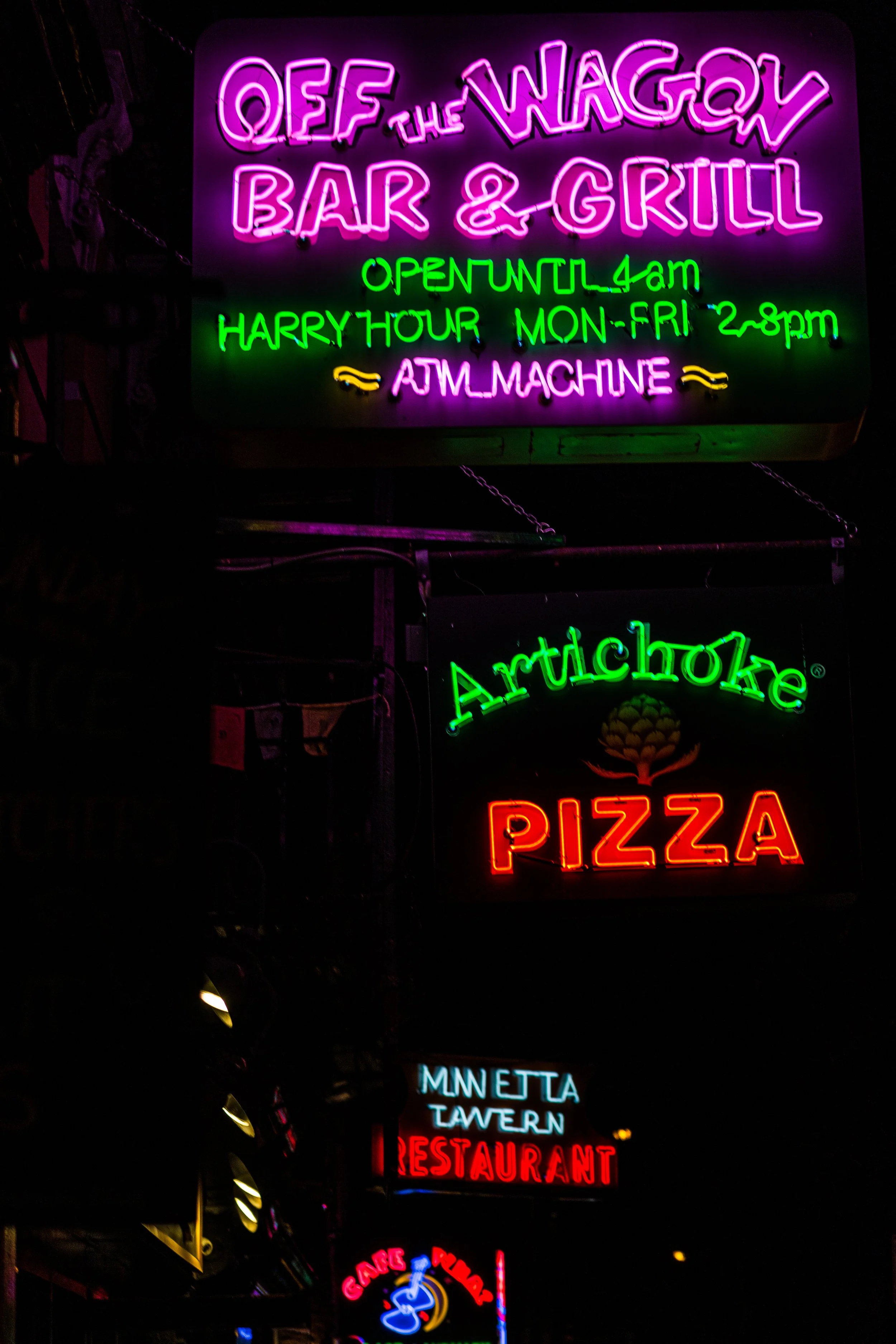
Greenwich Village Photographic Video
Late 20th Century: Counterculture and Identity
The 1960s–1970s reaffirmed the Village as the heart of American counterculture. Folk musicians like Bob Dylan, Joan Baez, and Phil Ochs rose from the open-mic stages of Café Wha? and Gerdes Folk City, turning Washington Square Park into an informal concert hall of the era’s conscience. The neighborhood also became a crucible of the LGBTQ+ rights movement: the Stonewall Riots of June 1969, centered at the Stonewall Inn on Christopher Street (just beyond Sixth Avenue’s western border), marked the birth of modern gay liberation.
Throughout the 1970s–1980s, the Village balanced creative ferment with political activism. Artists and activists alike fought rising rents and encroaching development. Meanwhile, the Greenwich Village Historic District, designated in 1969, became one of the largest and most consequential preservation zones in the United States—ensuring that the neighborhood’s 19th-century streetscape would remain intact even as its social composition evolved.
21st Century: Continuity, Change, and Cultural Reverence
In the 21st century, Greenwich Village stands as one of New York’s most storied neighborhoods—a physical and cultural palimpsest. While real estate values have soared, displacing many of the artists who once defined its spirit, its streets still radiate the energy of creation and resistance. New York University, whose campus surrounds Washington Square, has become both a steward and a source of contention—its expansions sparking debates about preservation versus progress.
Cultural landmarks endure: Caffe Reggio still serves espresso beneath Renaissance paintings; Judson Memorial Church continues its mission of social justice; and the Cherry Lane Theatre remains the city’s oldest continuously operating Off-Broadway house. The Stonewall National Monument (2016) enshrined the neighborhood’s civil rights legacy at the federal level, affirming the Village’s status not merely as a place but as an idea—a geography of freedom.
Today, as boutiques and brownstones coexist with university buildings and century-old bars, Greenwich Village remains the emotional heart of Manhattan’s cultural identity: a neighborhood where rebellion became heritage.
Greenwich Village Photo Gallery
Spirit and Legacy
Greenwich Village’s legacy is liberty made local. Its winding streets resist conformity, just as its people have long resisted orthodoxy—political, artistic, or architectural. From the writers and suffragists of the 1910s to the folk singers and activists of the 1960s, every generation has found here the freedom to invent itself anew.
New York City
Use this custom Google map to explore where every neighborhood in all five boroughs of New York City is located.
The Five Boroughs
One of New York City’s unique qualities is its organization in to 5 boroughs: Manhattan, Brooklyn, Queens, The Bronx, and Staten Island. These boroughs are part pragmatic administrative districts, and part vestiges of the region’s past. Each borough is an entire county in New York State - in fact, Brooklyn is, officially, Kings County, while Staten Island is, officially Richmond County. But that’s not the whole story …
Initially, New York City was located on the southern tip of Manhattan (now the Financial District) that was once the Dutch colony of New Amsterdam. Across the East River, another city was rising: Brooklyn. In time, the city planners realized that unification between the rapidly rising cities would create commercial and industrial opportunities - through streamlined administration of the region.
So powerful was the pull of unification between New York and Brooklyn that three more counties were pulled into the unification: The Bronx, Queens, and Staten Island. And on January 1, 1898, the City of New York unified two cities and three counties into one Greater City of New York - containing the five boroughs we know today.
But because each borough developed differently and distinctly until unification, their neighborhoods likewise uniquely developed. Today, there are nearly 390 neighborhoods, each with their own histories, cultures, cuisines, and personalities - and each with residents who are fiercely proud of their corner of The Big Apple.