
ASTORIA
Queens
Geographic Setting
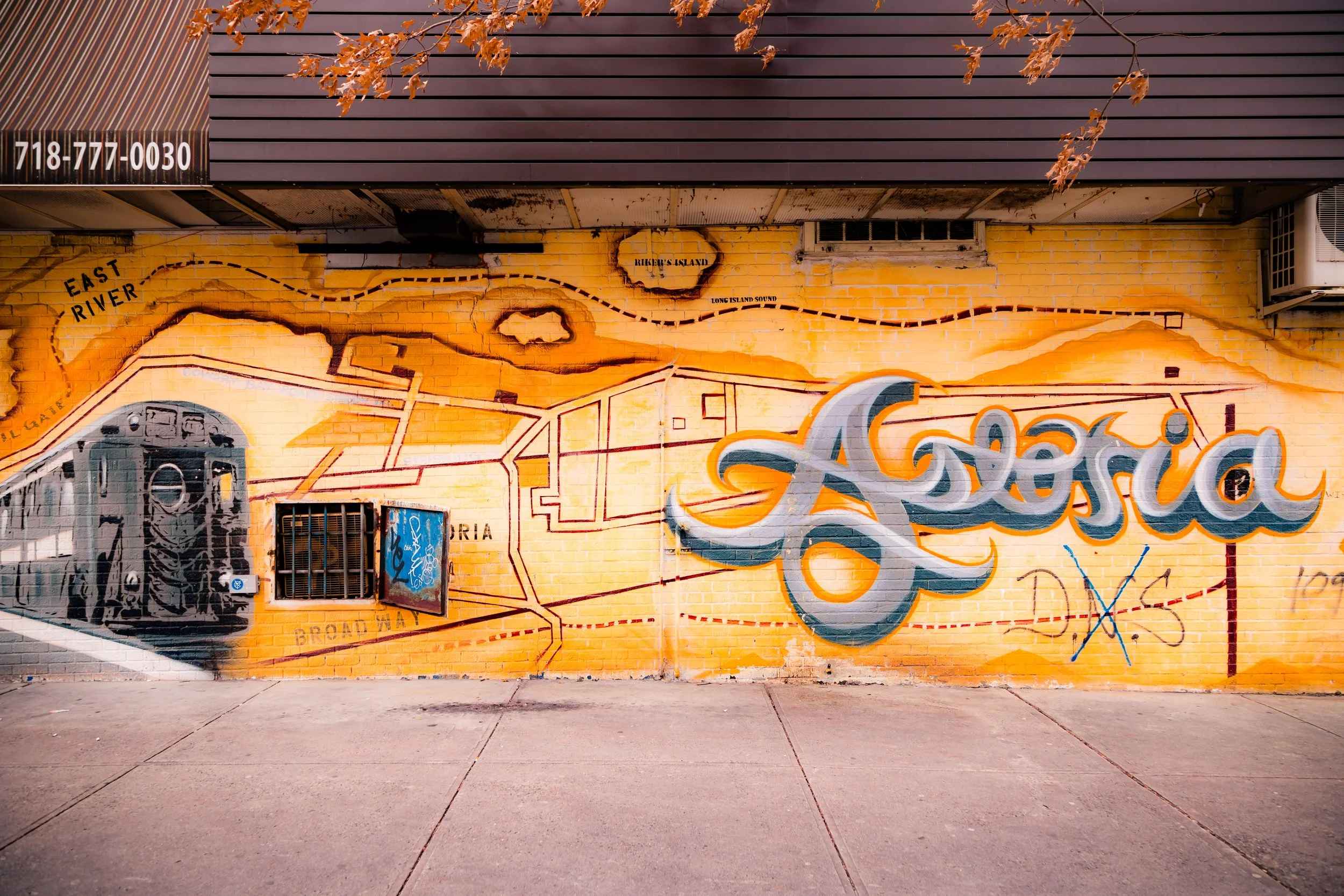
Bounded by the East River to the west, the Brooklyn–Queens Expressway (BQE) to the north and east, then tracing a southeastern line along 31st Avenue to 49th Street, south to 34th Avenue, west to Steinway Street, south to 36th Avenue, west to 31st Street, north to Broadway, and west again to the river, Astoria occupies the northwestern corner of Queens—a peninsula of life and labor whose riverfront commands some of the most dramatic views in New York. Its western edge overlooks Roosevelt Island and the towers of Manhattan, while inland avenues like Broadway, 30th Avenue, and Ditmars Boulevard pulse with urban energy. The neighborhood’s internal character shifts gradually from the apartment-lined corridors near the N and W trains to quieter residential blocks around Astoria Park, Steinway Street, and Shore Boulevard, where stoops, gardens, and bakeries form a rhythm both cosmopolitan and unmistakably local.
Astoria’s topography rises gently from the waterfront to a ridge near 31st Street, creating natural terraces that have long defined its streetscape. The neighborhood’s architecture mixes prewar apartment buildings, 19th-century frame houses, and postwar brick walk-ups, punctuated by corner taverns, Orthodox churches, and markets representing nearly every heritage of the modern city. The Hell Gate Bridge—its crimson arc stretching across the river—anchors the skyline, while Astoria Park’s 60 acres of open space, with its Depression-era pool and promenade, remain the civic heart of northwestern Queens.
Etymology and Origins
Astoria’s name honors John Jacob Astor (1763–1848), the German-American fur magnate once deemed the wealthiest man in the United States. The name was chosen in 1839 by Stephen A. Halsey, a fur merchant and entrepreneur who sought to elevate his fledgling village—then known as Hallet’s Cove—by associating it with Astor’s prestige. The irony, long noted in local lore, is that Astor never visited the community, contributing only a token investment of $500. Yet the name endured, and the district grew rapidly as a ferry-linked suburban outpost of Manhattan.
Before its rebranding, Hallet’s Cove had been settled by William Hallet, an Englishman who received a Dutch land patent in 1659. Hallet’s descendants maintained large estates along the river for generations, their orchards and farms supplying nearby New Amsterdam. By the early 19th century, industrialization along the East River and the development of ferry service to Manhattan drew investors eager to transform this pastoral shoreline into a genteel commuter village.
The Neighborhood
19th Century: Industry and Immigrant Foundations
Through the 1800s, Astoria evolved from rural hinterland to a dynamic hub of manufacturing and immigrant life. The Steinway & Sons Piano Company, founded in Manhattan by German craftsmen in 1853, relocated its operations here in the 1870s, creating Steinway Village—a model company town complete with worker housing, a church, a library, and even a streetcar line to the river. This enclave embodied 19th-century ideals of paternalistic industry: the belief that craftsmanship, order, and community uplift could coexist. Steinway’s world-class pianos—crafted in vast brick workshops that still stand near Steinway Place—carried the neighborhood’s name across the globe.
Astoria’s industrial expansion also drew breweries, shipyards, and metal foundries to its waterfront. German, Irish, and Italian immigrants arrived in waves, building small frame houses along Broadway and 30th Avenue, many still visible today. The completion of the Queensboro Bridge (1909) and the expansion of trolley lines solidified Astoria’s link to Manhattan, and its population swelled with working-class families seeking stability and opportunity. By the 1890s, Hallet’s Cove had merged with neighboring hamlets into the larger district of Astoria, now officially incorporated into Greater New York City.
Early 20th Century: The Cinematic Era and Civic Confidence
The dawn of the 20th century brought both cultural and architectural maturity. The neighborhood’s early grid was filled out with attached brick rowhouses, six-story apartment buildings, and churches serving its diverse congregations. The Astoria Studios, built by Famous Players–Lasky Corporation (later Paramount Pictures) in 1920 on 36th Street, turned the area into the beating heart of East Coast cinema. Silent film stars and vaudevillians frequented Steinway Street’s cafés and rehearsal halls, while local children peeked through studio gates hoping to glimpse the glamour of the new art form. The studio’s legacy persists today in Kaufman Astoria Studios, a revitalized complex that helped resurrect film production in New York during the late 20th century.
Civic life also flourished. The establishment of Astoria Park in 1913 provided a sweeping public space along the East River. Its WPA-era swimming pool, designed by architect Aymar Embury II and opened in 1936, became one of the city’s great recreational landmarks—site of Olympic trials, concerts, and countless summer afternoons. The park’s elevated promenade offered working-class families access to open water and sky, a democratic counterpoint to the exclusive clubs of Manhattan’s East Side across the river.
Astoria Photographic Video
Mid–Late 20th Century: Stability, Migration, and Cultural Continuity
Astoria’s population diversified throughout the 1930s–1950s as waves of immigrants—particularly Greeks fleeing war and political upheaval—settled alongside established Italian and Irish families. The arrival of Greek bakeries, Orthodox churches, and tavernas transformed 30th Avenue and Broadway into cultural corridors renowned for their hospitality. St. Demetrios Cathedral, founded in 1927, became both a spiritual and educational center for the growing Hellenic community, while local diners emerged as quintessential New York institutions.
The postwar decades brought both challenge and resilience. The construction of the Triborough Bridge (1936) and later the Astoria Houses (completed 1951) reshaped the waterfront. While some industries declined, Astoria maintained a strong working-class base centered around public service, transit, and small enterprise. In the 1960s and 1970s, amid citywide decline, the neighborhood’s solid housing stock and enduring ethnic institutions prevented the disinvestment that hollowed out many urban districts. Family-run groceries, butchers, and bakeries continued to anchor the avenues, and block associations worked tirelessly to preserve cleanliness and safety.
By the late 1980s, Kaufman Astoria Studios’ revival signaled renewed optimism. Film and television returned to the neighborhood, bringing productions like Sesame Street, Law & Order, and later streaming-era series, ensuring Astoria’s continued place in the cultural imagination.
21st Century: Reinvention and Global Mosaic
In the 2000s and 2010s, Astoria entered a period of reinvention without losing its essential soul. The neighborhood became a destination for young professionals, artists, and families drawn by its proximity to Manhattan and its lively, multicultural streetscape. 30th Avenue emerged as one of New York’s great dining boulevards, offering Greek seafood, Egyptian falafel, Balkan grills, Colombian bakeries, and modern cafés in seamless coexistence. Meanwhile, Socrates Sculpture Park, founded in 1986 on a reclaimed landfill at the waterfront, matured into a world-class open-air art space that reflects Astoria’s creative resilience.
New parks and esplanades—Hallets Point Park, Vernon Boulevard Promenade, and the expanded NYC Ferry service—have reconnected Astoria to its riverfront heritage. Redevelopment along the western edge, including mixed-use projects near Astoria Cove and Hallets Point, continues to reshape the skyline, though community groups remain vigilant to preserve affordability and character.
Despite gentrification pressures, Astoria’s essential rhythm endures. The clatter of dishes in 24-hour diners, the scent of coffee and grilled fish drifting down 30th Avenue, the bilingual chatter on stoops—all testify to a neighborhood where cosmopolitanism feels organic rather than imposed.
Astoria Photo Gallery
Spirit and Legacy
Astoria’s legacy is one of transformation through constancy—a working-class enclave that became a cultural crossroads without losing its humility. From Steinway’s industrial harmony to Kaufman Studios’ cinematic rebirth, from Greek churches to Egyptian hookah cafés, it has absorbed change with grace and vigor. The neighborhood’s energy lies not in spectacle but in coexistence: generations, languages, and livelihoods sharing the same sunlit streets.
New York City
Use this custom Google map to explore where every neighborhood in all five boroughs of New York City is located.
The Five Boroughs
One of New York City’s unique qualities is its organization in to 5 boroughs: Manhattan, Brooklyn, Queens, The Bronx, and Staten Island. These boroughs are part pragmatic administrative districts, and part vestiges of the region’s past. Each borough is an entire county in New York State - in fact, Brooklyn is, officially, Kings County, while Staten Island is, officially Richmond County. But that’s not the whole story …
Initially, New York City was located on the southern tip of Manhattan (now the Financial District) that was once the Dutch colony of New Amsterdam. Across the East River, another city was rising: Brooklyn. In time, the city planners realized that unification between the rapidly rising cities would create commercial and industrial opportunities - through streamlined administration of the region.
So powerful was the pull of unification between New York and Brooklyn that three more counties were pulled into the unification: The Bronx, Queens, and Staten Island. And on January 1, 1898, the City of New York unified two cities and three counties into one Greater City of New York - containing the five boroughs we know today.
But because each borough developed differently and distinctly until unification, their neighborhoods likewise uniquely developed. Today, there are nearly 390 neighborhoods, each with their own histories, cultures, cuisines, and personalities - and each with residents who are fiercely proud of their corner of The Big Apple.