
MIDWOOD PARK / FISKE TERRACE
Brooklyn
Geographic Setting
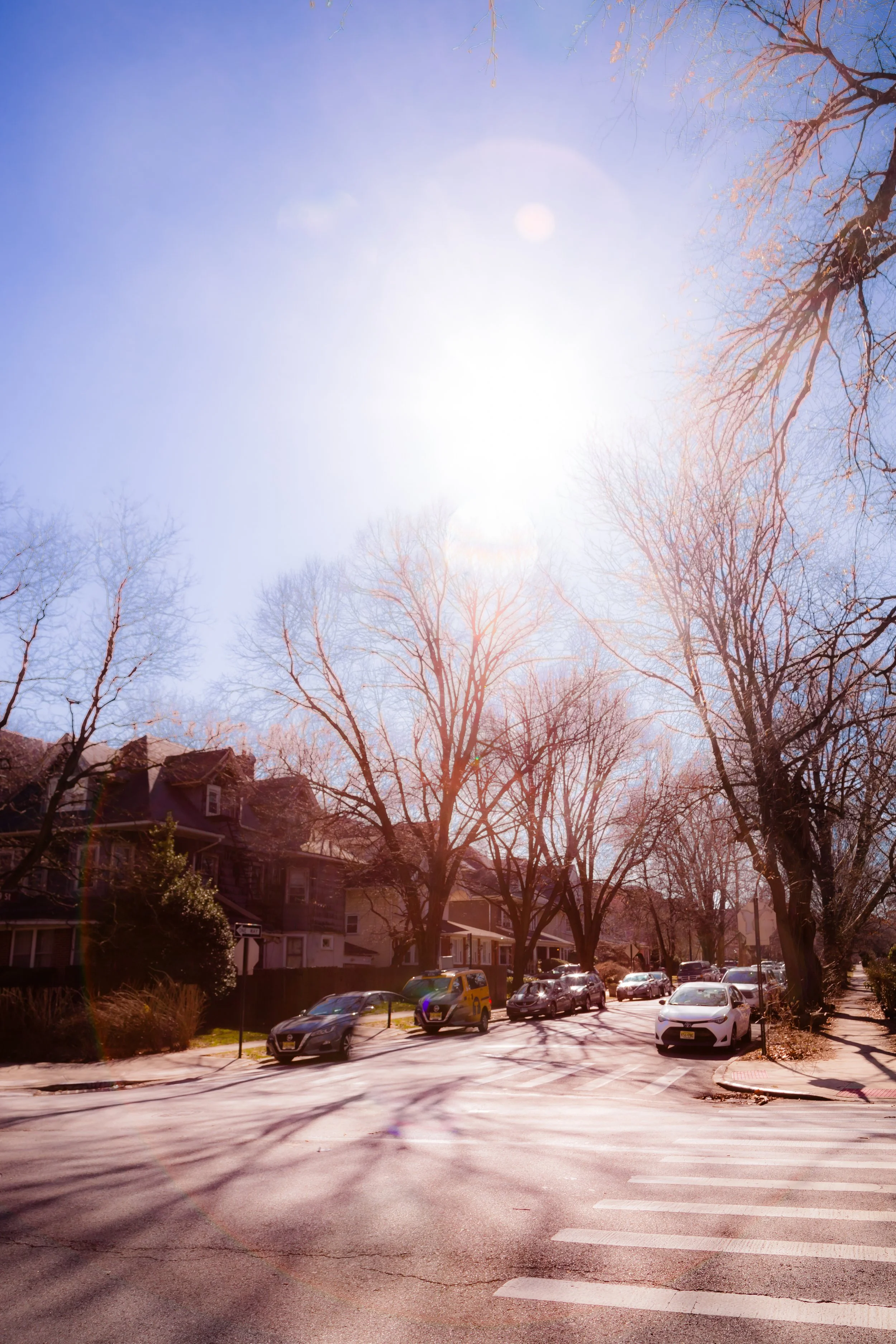
Bounded by the Long Island Rail Road tracks to the south, Coney Island Avenue to the west, Foster Avenue to the northwest, Flatbush Avenue to the northeast, and Nostrand Avenue to the east, Midwood Park and Fiske Terrace together form one of Brooklyn’s most elegant and historically cohesive residential enclaves. Tucked between Ditmas Park to the west and East Midwood to the east, this area—two adjoining planned suburban developments built in the early 20th century—stands as a living museum of American domestic architecture: tree-lined streets, sweeping lawns, and freestanding homes designed in an astonishing variety of styles, all within the fabric of a modern metropolis.
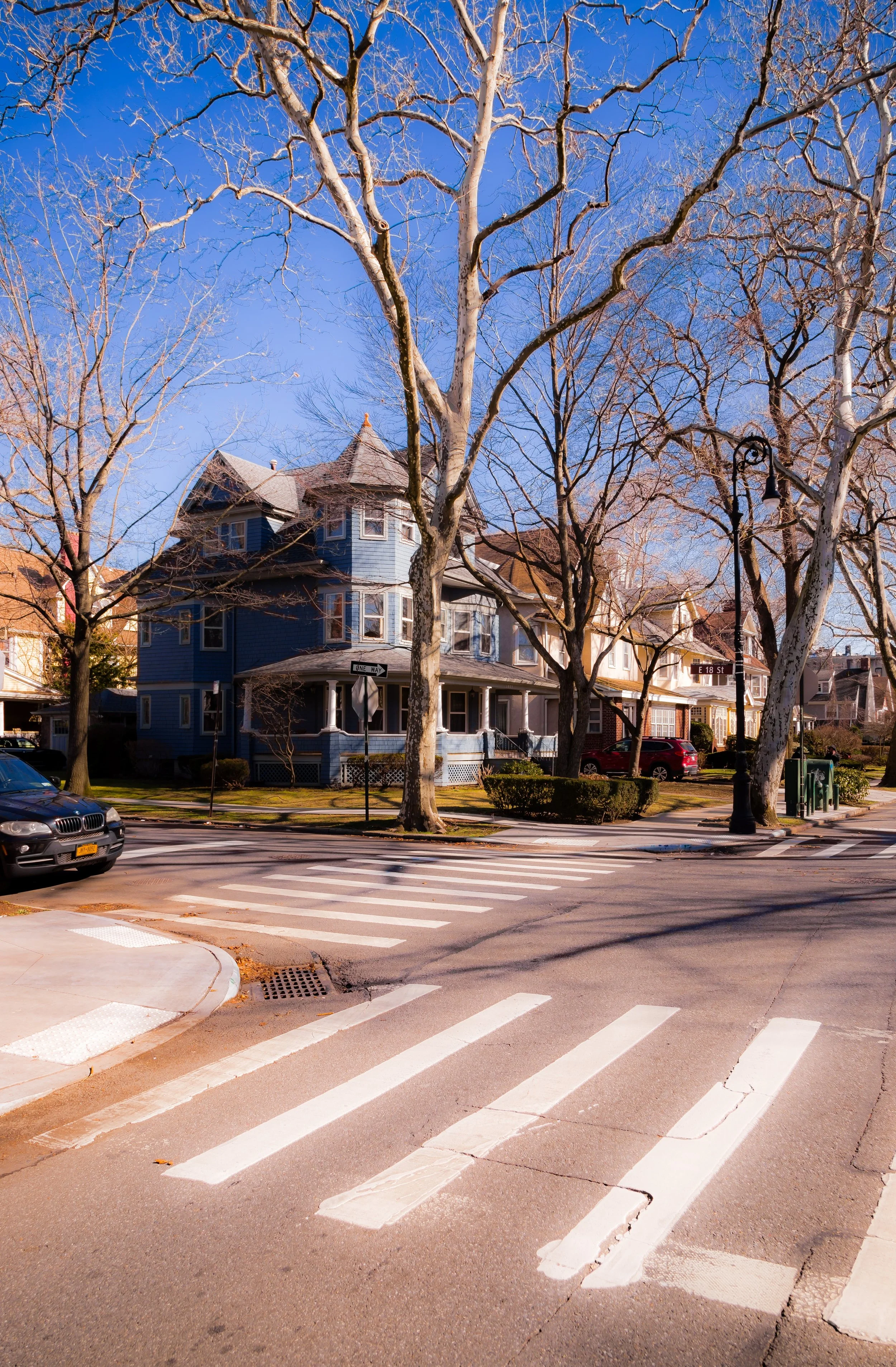
Despite their proximity to busy Flatbush and Coney Island Avenues, both Midwood Park and Fiske Terrace retain an atmosphere of seclusion. The streets—Glenwood Road, Avenue H, Farragut Road, and East 17th through East 22nd Streets—curve gently beneath a dense canopy of century-old oaks and maples. The Avenue H station (Q line), housed in a charming wooden cottage that once served as the Fiske Terrace real estate office, anchors the neighborhood’s identity as both historically preserved and intimately lived-in.
Etymology and Origins
The names Midwood Park and Fiske Terrace reflect their early-20th-century origins as carefully planned garden suburbs. “Midwood” derives from the Dutch Midwout, meaning “middle woods,” a reference to the dense forest that once covered this central stretch of Brooklyn; “Fiske Terrace” honors the Fiske family, who owned and developed the land in partnership with the T.B. Ackerson Company, one of Brooklyn’s leading real estate firms.
Before the turn of the century, this region was part of the rural Town of Flatbush, consisting mainly of farmland, woodlots, and the remnants of the great Midwood forest. It was not until the completion of the Brooklyn Rapid Transit Company’s Brighton Line (today’s B/Q subway) and the advent of electric trolley service along Flatbush Avenue in the late 1800s that large-scale residential development became feasible.
The Neighborhood
Early 20th Century: Planned Suburbia in the “Middle Woods”
Between 1905 and 1910, the T.B. Ackerson Company transformed these former farmlands into two coordinated residential developments—Fiske Terrace to the east of the Brighton Line, and Midwood Park to the west. Together they embodied the ideals of the Garden Suburb Movement, offering urban families the promise of suburban living—spacious lots, detached houses, and natural landscaping—within the reach of rapid transit to Manhattan.
Ackerson’s approach was meticulous. Streets were graded and paved, water and sewer lines installed, and hundreds of trees and shrubs planted before construction began. The company even built sample homes to display its vision of tasteful domesticity. Deed restrictions required detached single-family houses set back from the street, ensuring light, air, and privacy. Unlike the dense tenement districts farther north, these neighborhoods would be built “for homes, not houses.”
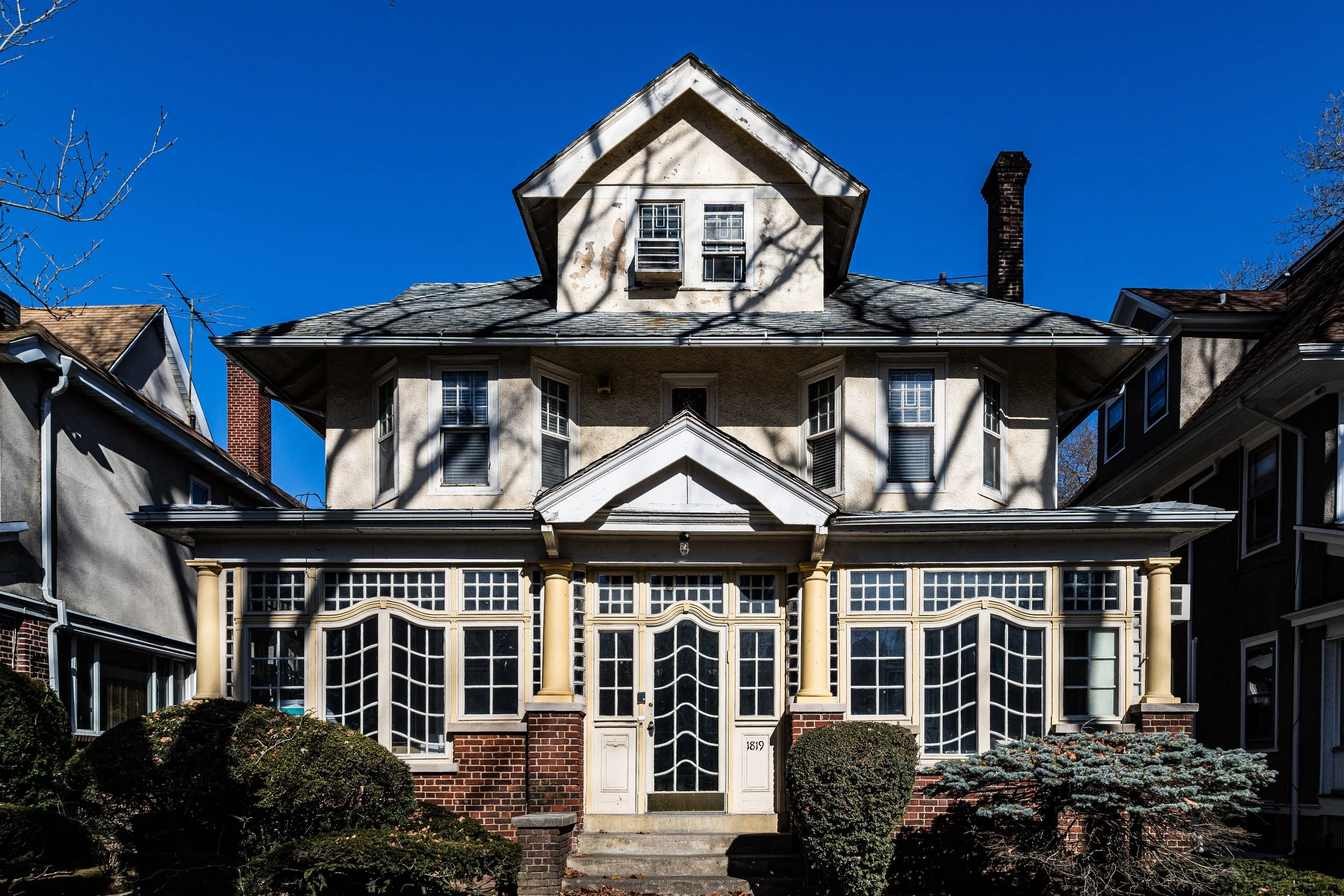
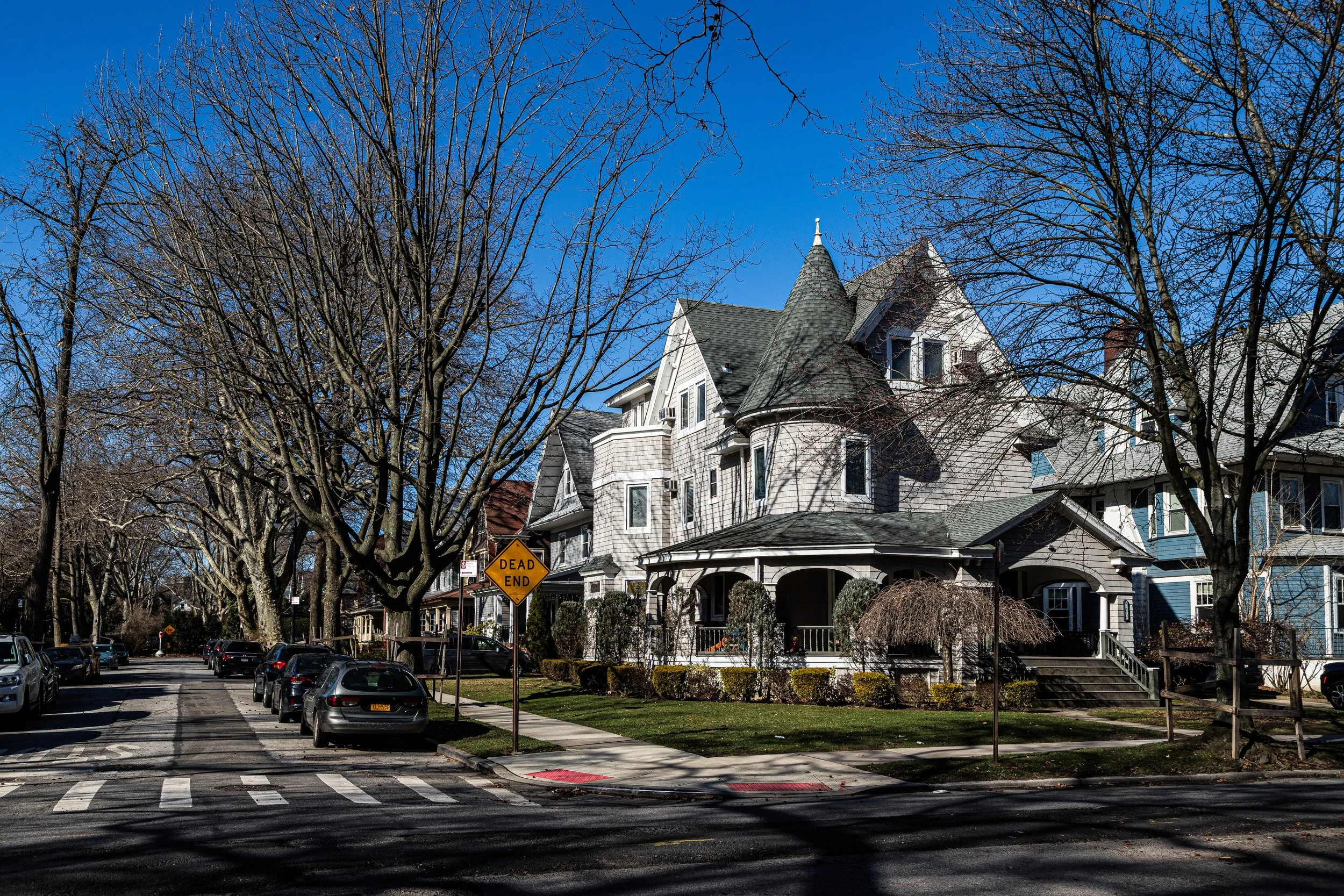
The architectural results were extraordinary. Within a decade, builders had erected more than 600 freestanding homes in styles ranging from Colonial Revival and Tudor to Arts and Crafts, Mission, and Prairie School. Many were designed by noted architects of the day—John J. Petit, Benjamin Driesler, and Slee & Bryson—and featured generous porches, bay windows, and fine woodwork. Streets like East 17th Street, Glenwood Road, and Avenue H became showcases of early suburban artistry.
Fiske Terrace, in particular, distinguished itself with a higher elevation, gentle slopes, and a dense canopy of oaks that predated its houses. Midwood Park, immediately to the west, complemented it with slightly smaller lots but equally gracious designs. Both were marketed to upper-middle-class professionals—lawyers, merchants, and educators—seeking respite from the city’s congestion.
Mid–20th Century: Stability and Community Life
Through the 1920s–1950s, Midwood Park and Fiske Terrace matured into two of Brooklyn’s most stable and sought-after residential enclaves. Their location near Brooklyn College (opened 1930) and Midwood High School (opened 1940) drew academic and civic-minded residents, while the presence of synagogues and churches reflected the neighborhood’s growing diversity.
The community’s suburban qualities—detached homes, private gardens, tree-lined streets—remained remarkably intact even as surrounding districts urbanized. Many of the original homeowners’ descendants stayed for generations, and the neighborhood’s architectural integrity was maintained through pride rather than policy. During these decades, modest modernization—indoor plumbing upgrades, enclosed porches, and finished attics—coexisted with a deep respect for the homes’ original craftsmanship.
The Avenue H train station, built in 1906 as the Ackerson Company’s sales office, became a beloved local landmark. When the city threatened to demolish it in the 1970s, residents successfully campaigned for its preservation, leading to its designation as a New York City Landmark in 2004—the only subway station in the city housed in a wooden cottage.
Midwood Park Photographic Video
Late 20th Century: Preservation and Change
By the 1970s and 1980s, Midwood Park and Fiske Terrace were recognized as architectural treasures. As many Brooklyn neighborhoods faced decline or overdevelopment, these twin enclaves remained well-preserved examples of early-20th-century suburban planning. Residents organized civic associations and successfully lobbied for protective zoning to prevent multifamily conversions and the encroachment of commercial structures.
The neighborhoods’ demographics gradually diversified, welcoming Jewish, Caribbean, South Asian, and Eastern European families while retaining the quiet, family-oriented atmosphere that had defined them since their inception. The Fiske Terrace Association and the Midwood Park Homeowners Association became active voices for preservation and environmental stewardship, especially regarding street tree maintenance and landmark protection.
In 2008, after decades of advocacy, the New York City Landmarks Preservation Commission officially designated the Fiske Terrace–Midwood Park Historic District, safeguarding over 250 homes across both neighborhoods. This recognition celebrated the area’s architectural coherence, its landscape design, and its near-total survival from the original Ackerson plan—a rarity in urban America.
21st Century: Heritage and Livability
In the 21st century, Midwood Park and Fiske Terrace stand as two of Brooklyn’s most serene and architecturally intact residential districts. Their leafy streets remain havens of calm amid the city’s rapid change. The houses—most lovingly maintained or restored—retain their original woodwork, stained glass, and porches. New generations of residents, drawn by the blend of history and community, continue the tradition of care.
The neighborhoods’ proximity to Brooklyn College, Avenue H station, and the Flatbush commercial corridor keeps them well-connected yet quietly apart. Community life revolves around local schools, churches, and synagogues, and seasonal events—yard sales, block parties, and garden walks—reinforce the small-town feel that Ackerson envisioned over a century ago.
Preservation remains central to their identity: tree replacement programs, careful zoning oversight, and ongoing partnerships with preservation organizations ensure that Midwood Park and Fiske Terrace remain a living record of Brooklyn’s early suburban experiment. The soundscape—chirping birds, footsteps on flagstone, and the distant hum of the Q train—feels far removed from the city’s intensity, yet unmistakably part of its fabric.
Midwood Park Photo Gallery
Spirit and Legacy
The spirit of Midwood Park and Fiske Terrace is one of planned beauty and enduring stewardship. Conceived at a moment when the city’s edge was shifting southward, these neighborhoods captured a vision of balance between nature and architecture—one that has survived into the 21st century almost unchanged.
Their legacy lies not only in their gables and porches but in their lived continuity: century-old homes still inhabited by families who value quiet, craftsmanship, and community.
New York City
Use this custom Google map to explore where every neighborhood in all five boroughs of New York City is located.
The Five Boroughs
One of New York City’s unique qualities is its organization in to 5 boroughs: Manhattan, Brooklyn, Queens, The Bronx, and Staten Island. These boroughs are part pragmatic administrative districts, and part vestiges of the region’s past. Each borough is an entire county in New York State - in fact, Brooklyn is, officially, Kings County, while Staten Island is, officially Richmond County. But that’s not the whole story …
Initially, New York City was located on the southern tip of Manhattan (now the Financial District) that was once the Dutch colony of New Amsterdam. Across the East River, another city was rising: Brooklyn. In time, the city planners realized that unification between the rapidly rising cities would create commercial and industrial opportunities - through streamlined administration of the region.
So powerful was the pull of unification between New York and Brooklyn that three more counties were pulled into the unification: The Bronx, Queens, and Staten Island. And on January 1, 1898, the City of New York unified two cities and three counties into one Greater City of New York - containing the five boroughs we know today.
But because each borough developed differently and distinctly until unification, their neighborhoods likewise uniquely developed. Today, there are nearly 390 neighborhoods, each with their own histories, cultures, cuisines, and personalities - and each with residents who are fiercely proud of their corner of The Big Apple.