
THE PENN DISTRICT
Manhattan
Neighborhood Profile
A monumental gateway defined by relentless movement and architectural transition, the Penn District is the city’s high-stakes "interregnum" between mid-century industrial grit and hyper-modern renewal. Centered on the logistical complexity of Pennsylvania Station and the soaring glass of the new Moynihan Train Hall, the district is a place of massive scale—where the stoic weight of pre-modernist masonry stands in constant, visible dialogue with the crystalline supertalls reshaping the Midtown West skyline.
Geographic Setting
Stretched from Sixth Avenue west to Ninth Avenue between West 30th and West 34th Streets, the Penn District forms a thick, infrastructural belt of Midtown—one built around motion. Its center of gravity is Pennsylvania Station, with Madison Square Garden perched above the tracks and concourses, compressing an astonishing amount of civic throughput into a few blocks.
The avenues here behave like channels. Seventh and Eighth carry the loudest currents—commuters, event crowds, deliveries, taxis—while Ninth marks the western seam where the city starts to open toward the river-facing grid and newer development further north and west. This is a neighborhood defined less by a picturesque skyline than by pressure, velocity, and the choreography of arrivals.
Etymology and Origins
“Penn District” is a contemporary banner—a name that takes the older, familiar shorthand of Penn Station and turns it into a neighborhood identity. In practice, it signals a shift in how the area is being presented: not merely “the blocks around the station,” but a district with a curated streetscape, branded public space, and a redevelopment narrative. Vornado Realty Trust is one of the major amplifiers of this naming, using “PENN District” as a framework for a cluster of upgraded buildings, plazas, and ground-level retail around the station.
For many years, these same blocks were comfortably bundled into “Midtown South,” a latitude label rather than a story. The new name doesn’t erase that recent usage so much as refine it—pulling this transit core into sharper focus and admitting that it has always lived by different rules than the blocks east of Sixth.
The Neighborhood
19th Century:
In the 1800s, this stretch sat on the city’s northward climb, shaped by the grid, industry, and the steady westward pull of commerce. Long before the station’s monumental era, the neighborhood’s identity was already practical: warehouses, workshops, and the kinds of businesses that benefit from straight avenues and proximity to rail and ferry systems. The bones of a working district were already in place—built for movement, not repose.
Early 20th Century:
The decisive transformation arrived with the original Pennsylvania Station, opened in 1910—a civic-scale project that stitched the city to regional rail in a new way and made this area one of New York’s great thresholds. The station’s presence reorganized everything around it: hotels, commerce, and pedestrian flows, but also the invisible architecture of habit—where people met, where they waited, how they understood distance.
This was also the era when “Midtown South” begins to make sense as a broad descriptor: Midtown expanding, the garment economy nearby, and the station district acting as an intake valve for people and goods. But even then, the blocks closest to Penn were their own creature—less neighborhood than interchange.
Empire District Photograph Slideshow
Mid-20th Century:
The mid-century period gave the Penn area its most famous wound and its most enduring controversy: the demolition of the original aboveground station structure beginning in the 1960s and the reconfiguration of the complex beneath a new arena and office development. For many New Yorkers, this became a civic parable about what the city chooses to preserve and what it chooses to trade away.
Functionally, the district remained what it had always been: a place that exists to process crowds. But aesthetically and psychologically, it hardened into something more severe—more fluorescent, more compressed—an environment that many experienced as a necessary passage rather than a destination.
Late 20th Century:
From the 1970s through the 1990s, the Penn area lived in a kind of limbo: indispensable, heavily trafficked, and strangely underloved. “Midtown South” was a convenient umbrella during these decades precisely because it allowed the station blocks to disappear into general Midtown-ness. Yet the station district’s day-to-day reality—its constant churn, its layered transit complexity, its commerce built around volume—was distinct.
Over time, the idea of “fixing Penn” became a recurring civic refrain, returning in cycles with new plans, new renderings, and new promises to make the neighborhood feel less like an obligation and more like a front door.
21st Century:
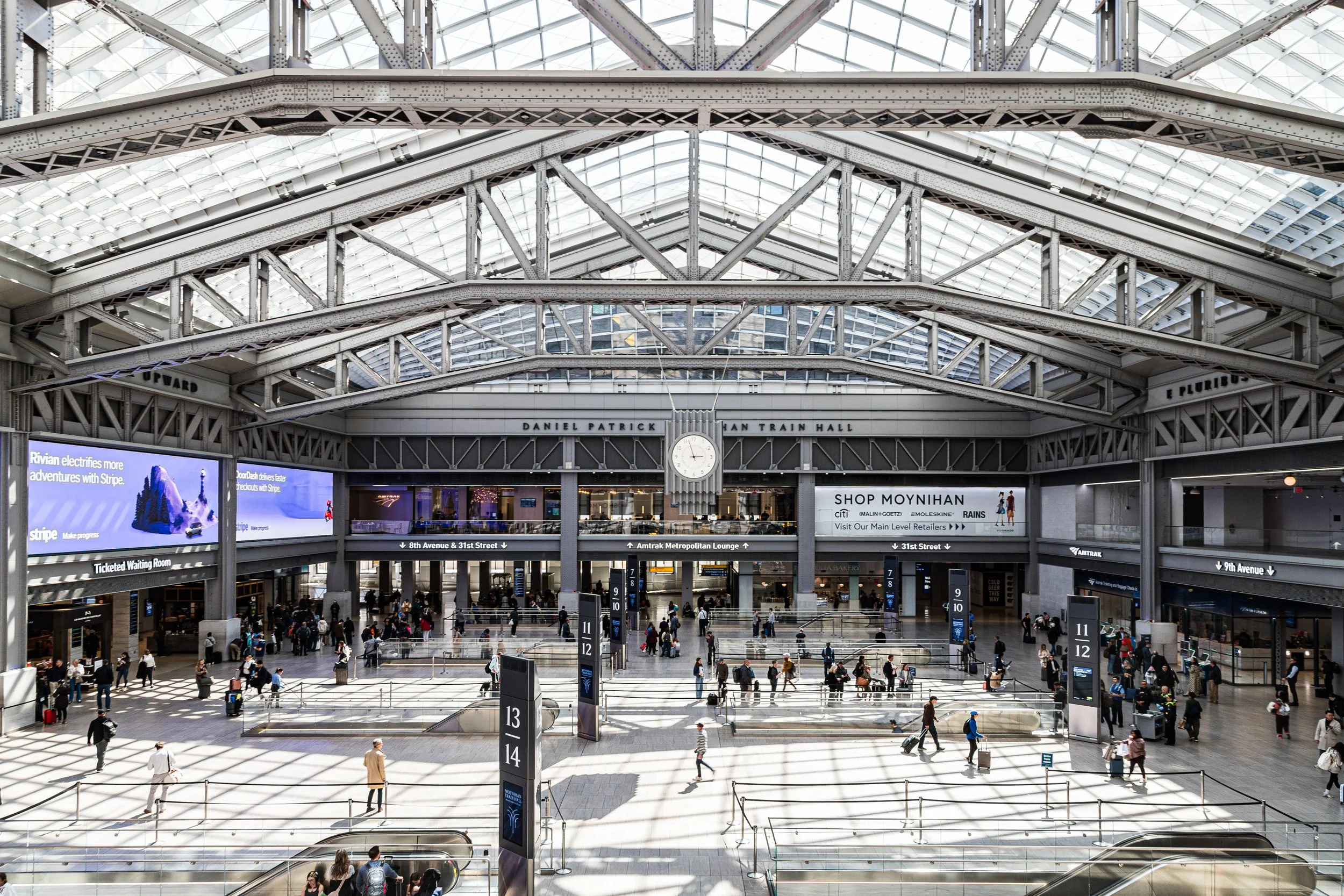
In the 21st century, that long-running impulse crystallized into a more coordinated effort to remake both the experience of the station and the street life around it—new public spaces, revamped buildings, and the attempt to restore dignity and legibility to the commuter realm. The opening of Moynihan Train Hall added a major new civic room to the Penn ecosystem and strengthened the “gateway” identity that the Penn District name tries to capture.
This is also the moment when the Penn District label does real work for your project: it acknowledges that the area has shifted from being a “Midtown South” slice people passed through to a place being consciously authored—marketed, redesigned, and increasingly expected to stand for something.
Empire District Photo Gallery
Through The Lens
A District in Interregnum
The visual legacy of the Penn District is one of constant, often controversial, evolution. During my 2014 visit, I sought to document the neighborhood during a quiet pause between its storied past and its eventual hyper-modern makeover, focusing on the sheer verticality and varied textures of its transit-oriented architecture.
Photographer's Insight:
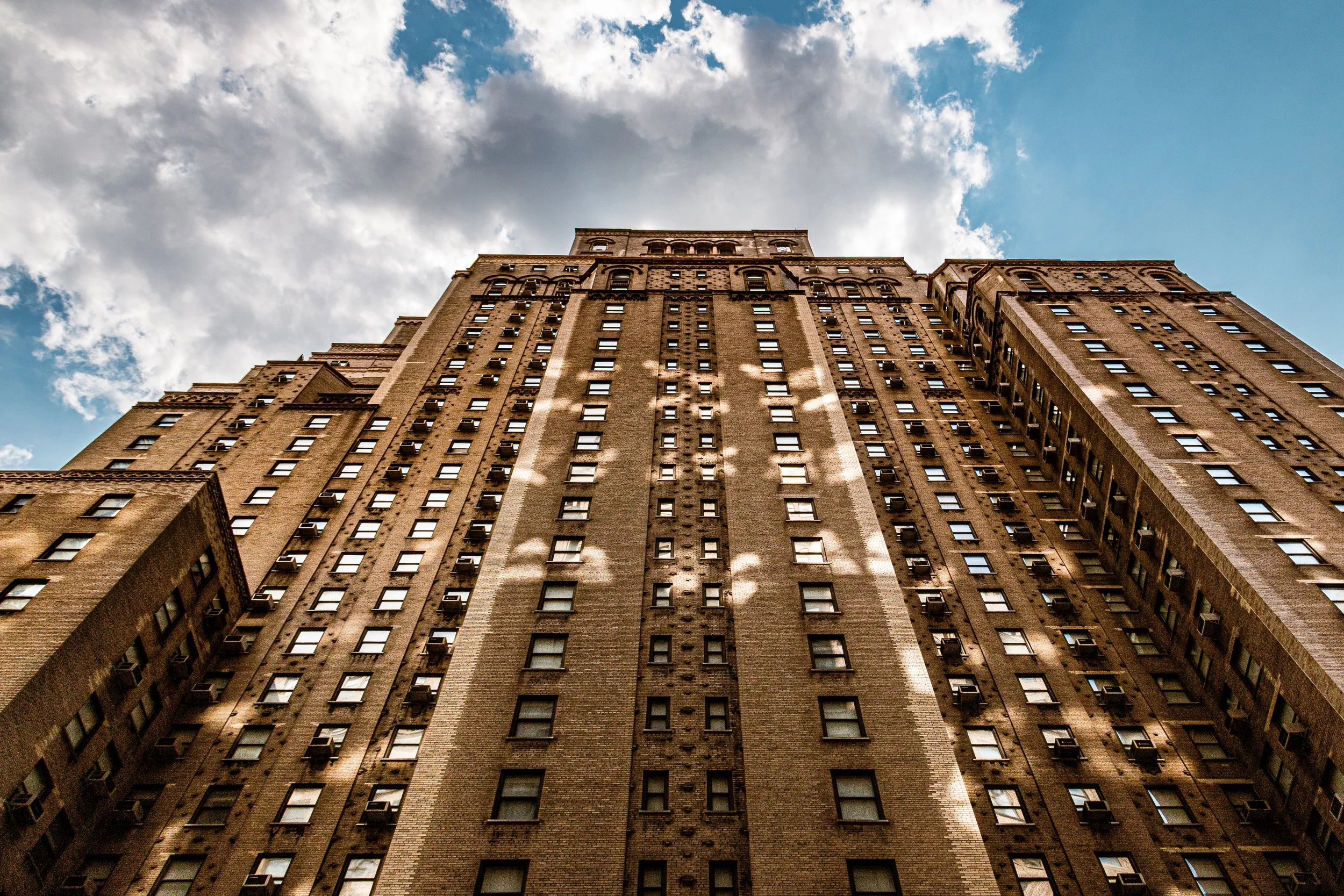
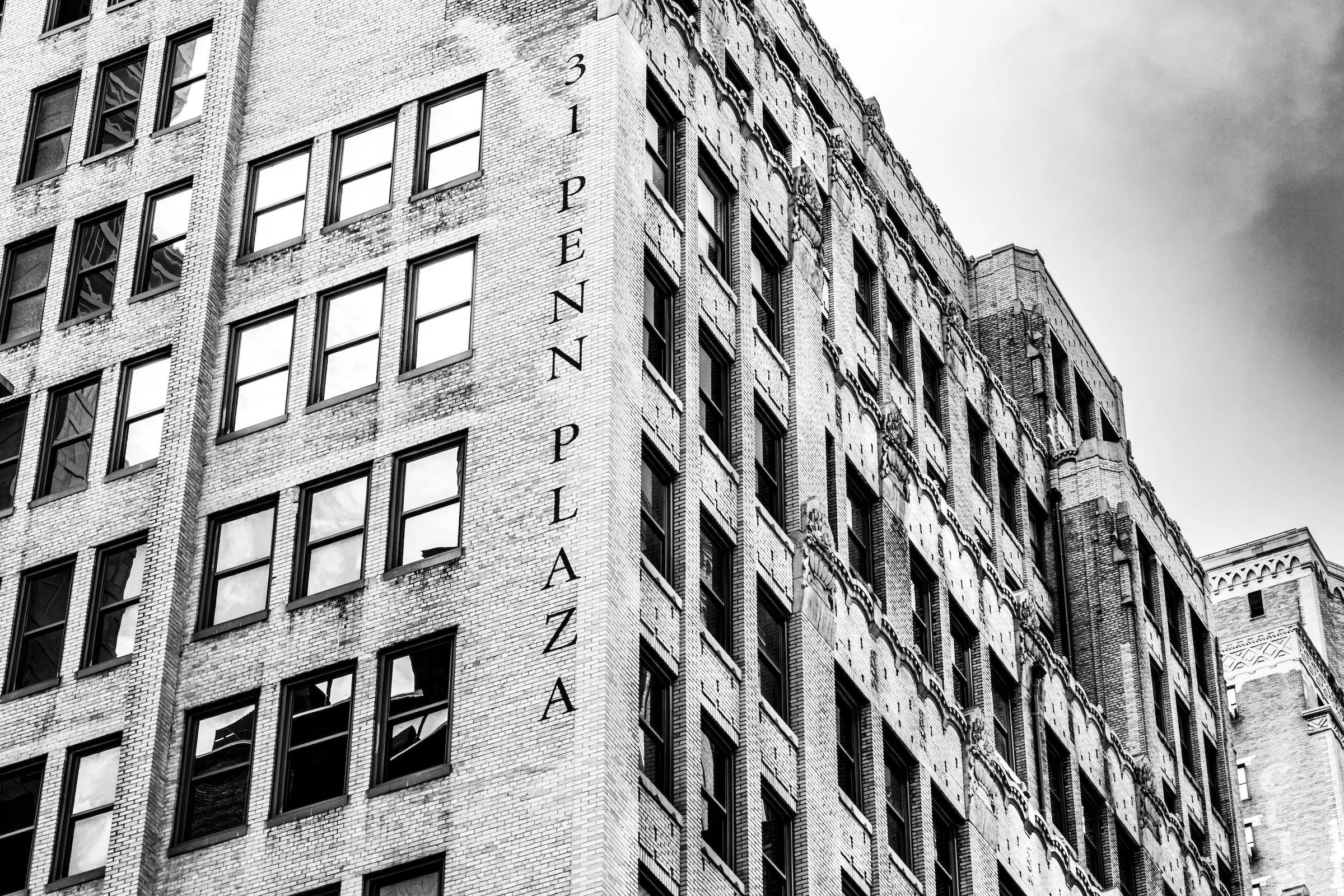
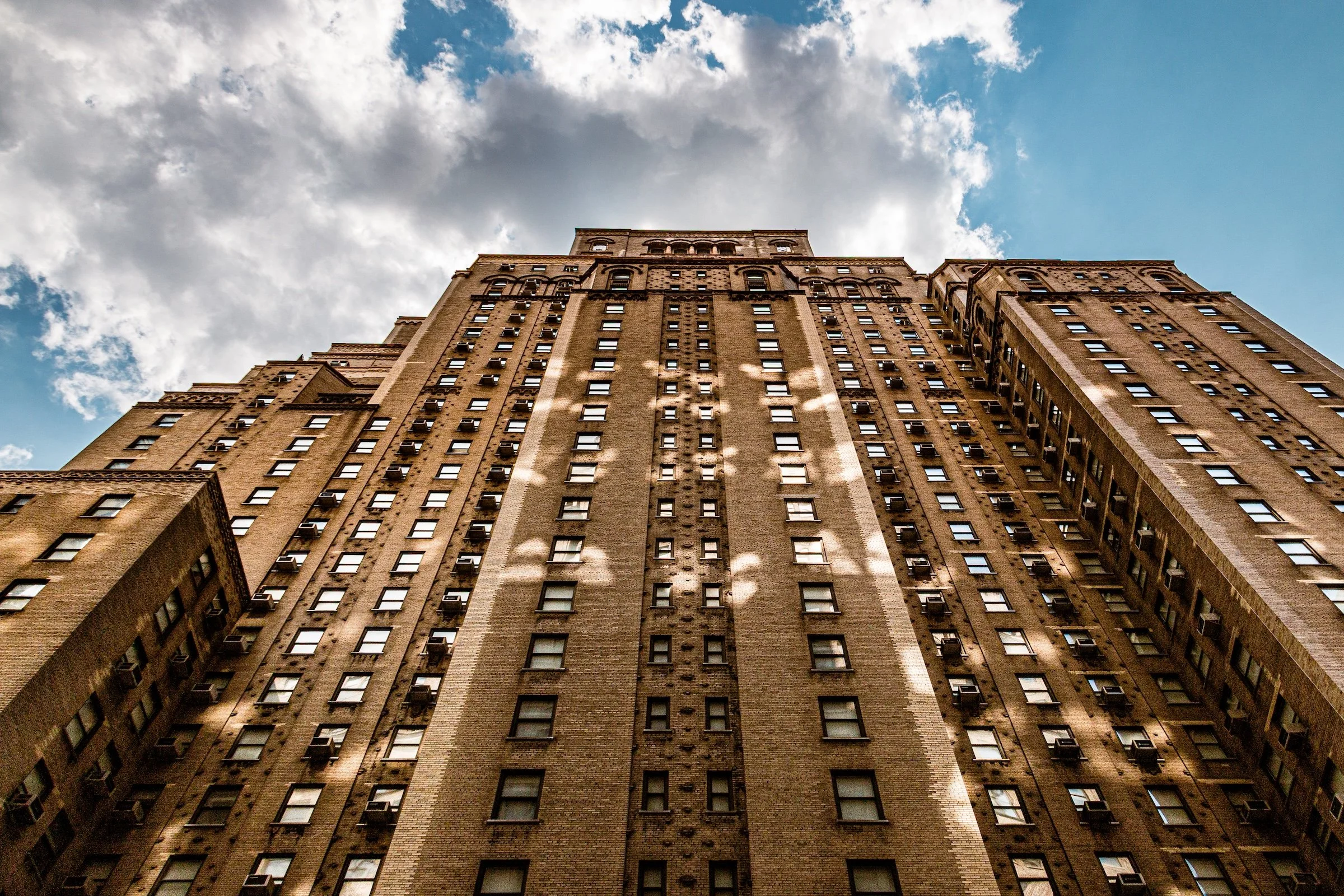
The Weight of History: I focused on the "stark" and "sturdy" characters of the pre-modernist skyline. In “31 Penn Plaza”, the sharp, black-and-white contrast emphasizes the geometric precision of the masonry and the bold typography of 31 Penn Plaza. Similarly, the upward-angled perspective of the Hotel Pennsylvania (“Affinia Sunflections”) captures a textured expanse of windows and brick that has since faced the "relentless progress" of the city.
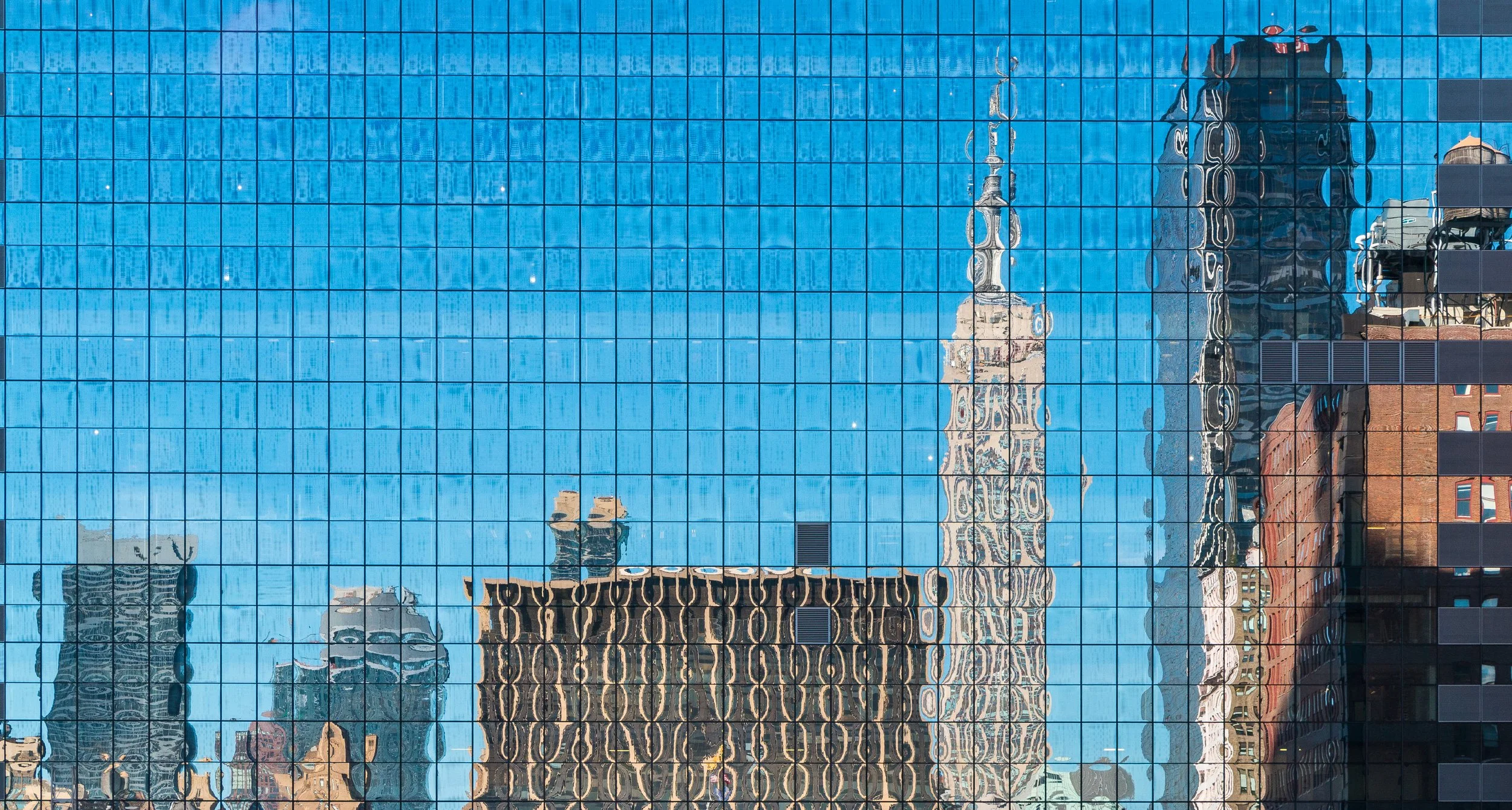
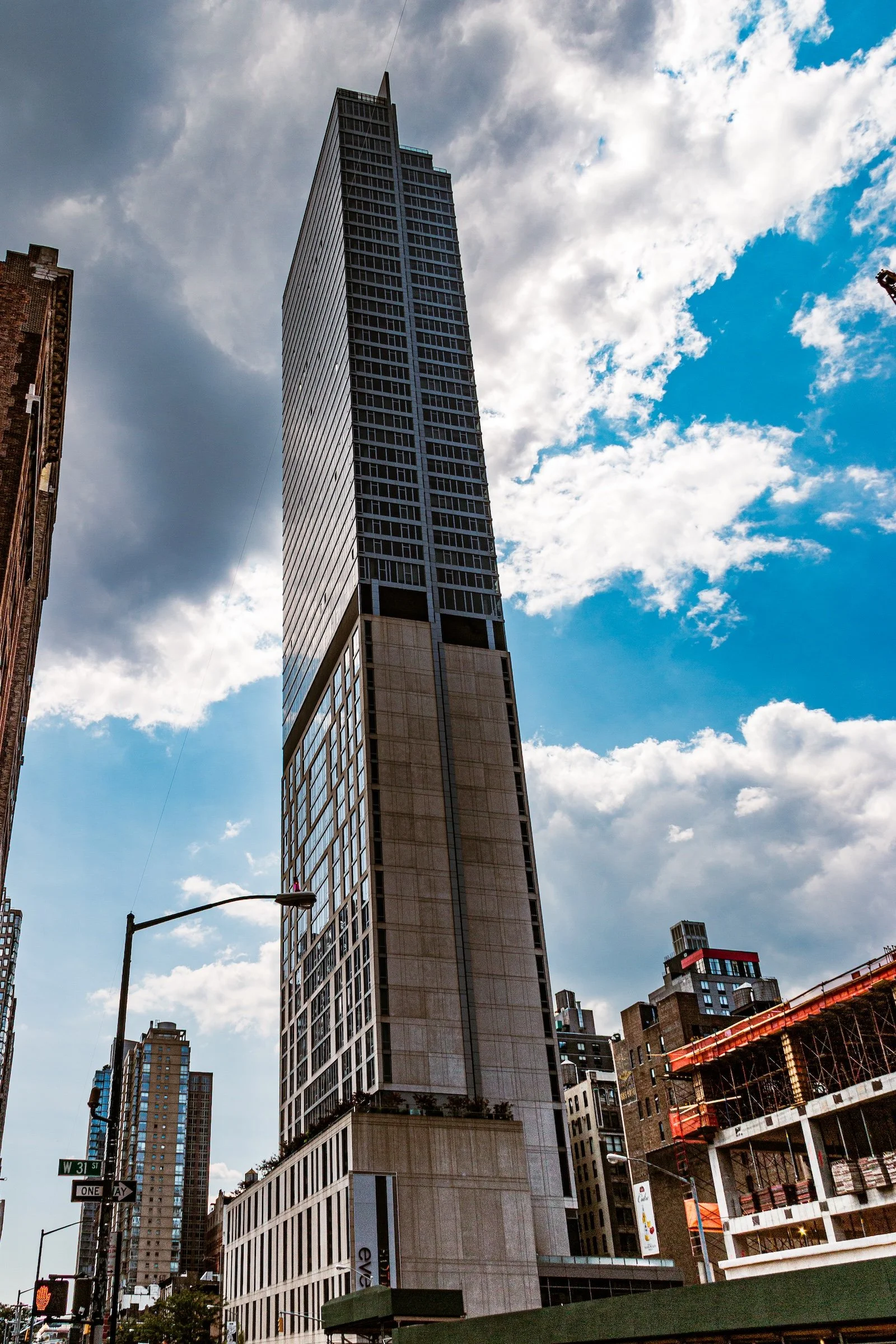
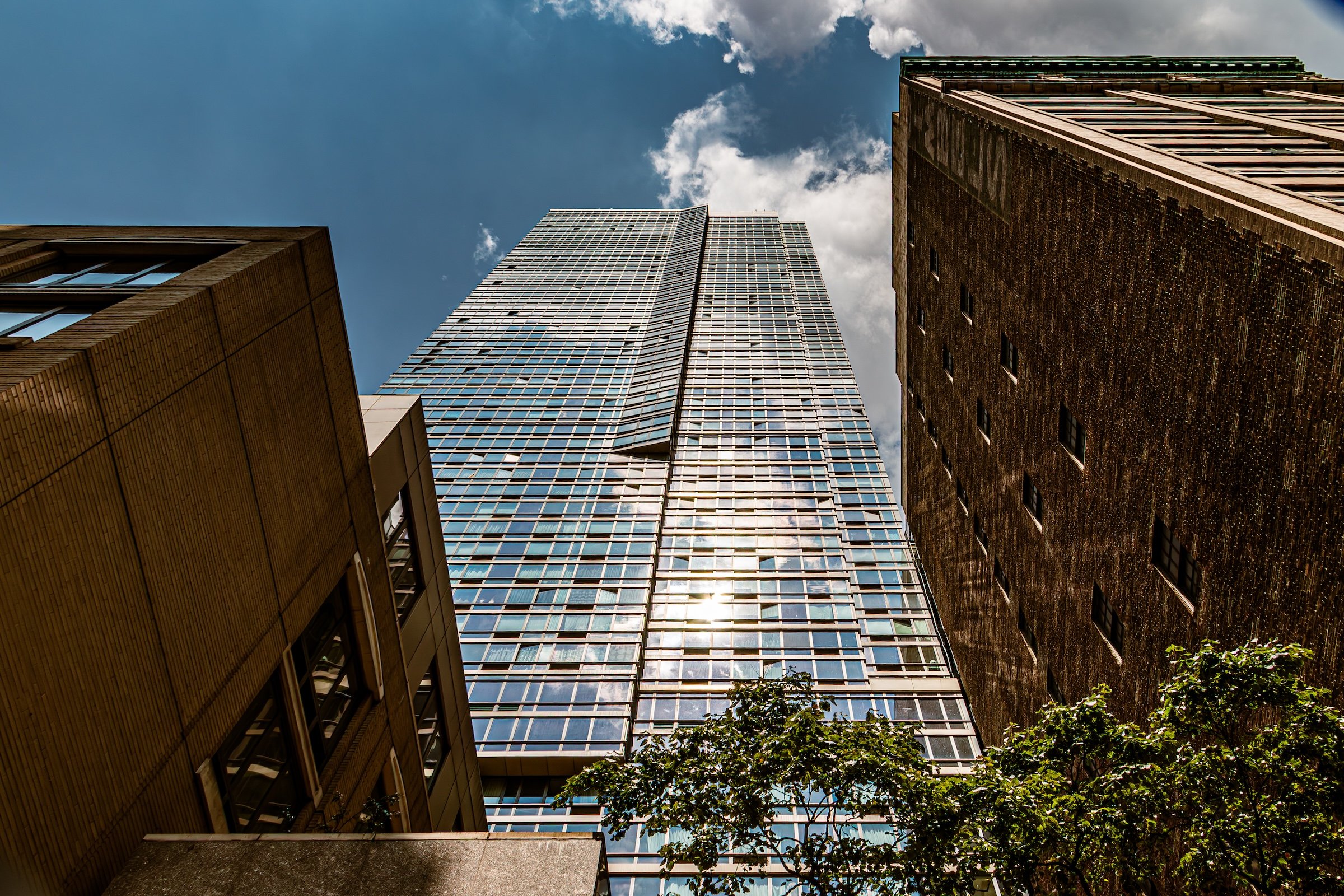
Reflections of Change: I sought to capture the district's "Spirit" through its new vertical silhouettes. The low-angle capture of a glass tower in “The Epic” illustrates the encroaching future; the way the glass reflects the surrounding clouds and neighboring brickwork serves as a visual bridge between the district’s disparate eras.
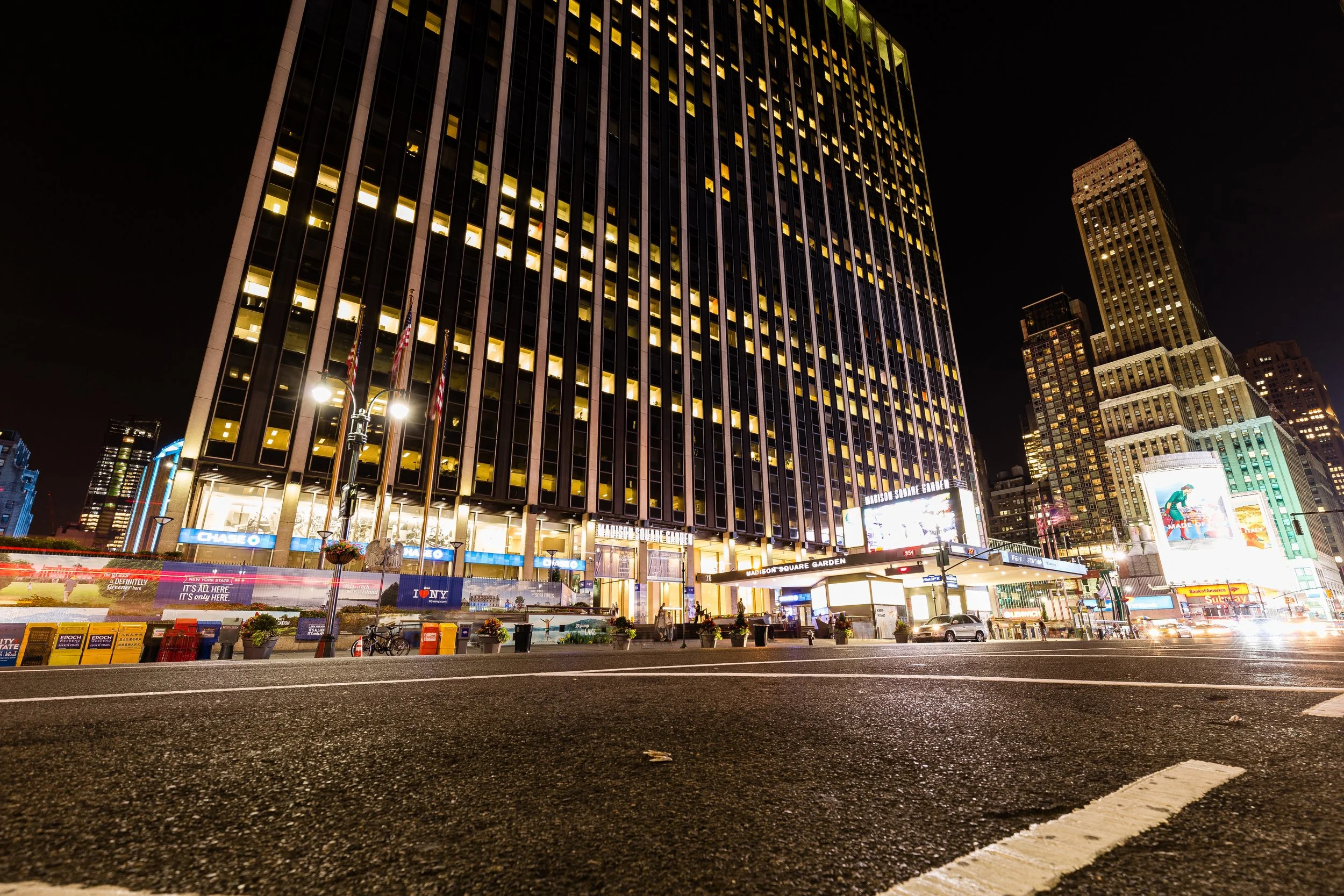
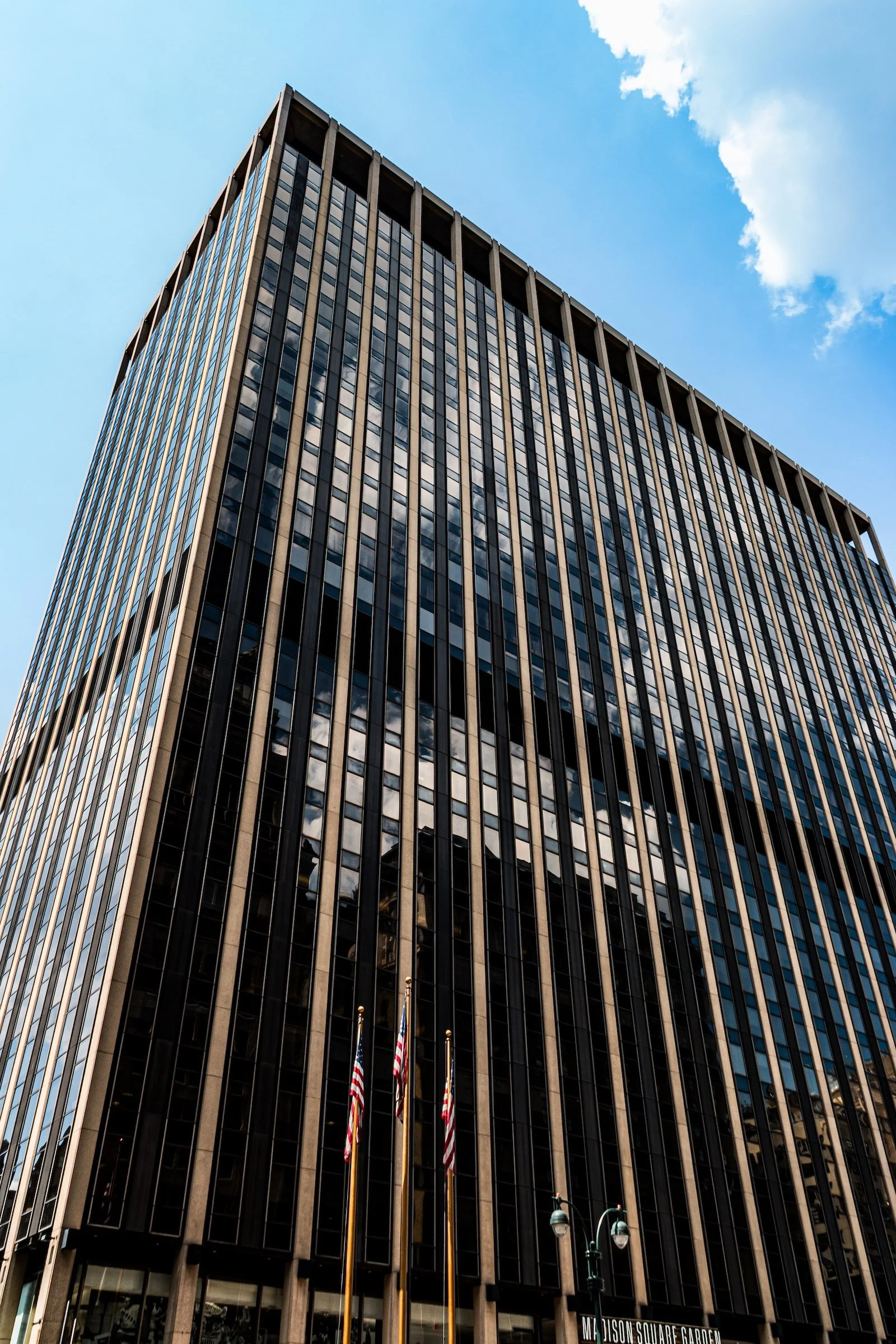
Transit Shadows: I documented the massive, dark glass skin of Two Penn Plaza (“Madison Square Garden Offices“), noting how its monolithic profile and the flags of Madison Square Garden stand as an imposing anchor for the transit hub. The play of light on its reflective surface against the deep blue sky emphasizes the district’s role as a place of high-density movement and monumental scale.
Spirit and Legacy
The Penn District’s legacy is a paradox: it is one of the city’s most essential places, yet it has rarely been loved in the way neighborhoods are loved. Its story is about thresholds—how New York receives the world, how it funnels human tides, how it negotiates between civic grandeur and infrastructural compromise. Keeping the “Midtown South” lineage in view helps readers understand what changed: the district didn’t suddenly become important; it became newly named, newly curated, newly claimed.
And in that naming is a quiet cultural pivot. “Penn District” is the city admitting, at last, that the station blocks aren’t just a backdrop—they are a face.
Penn District Field Notes
-
Field Note: August 10, 2014 | 01:44 PM
Conditions: 83°F | Humidity: 43% (Daily Low)
Penn District served as the gateway for today’s documentation, and I was struck by the heavy, transitional energy of the blocks surrounding the station. Standing beneath the massive, rhythmic facades of landmarks like 31 Penn Plaza (“31 Penn Plaza”) and the Hotel Pennsylvania (“Affinia Sunflections”), I felt the weight of the district's mid-century glory. Even as the high August sun glinted off the glass of rising newcomers (“The Epic”), the grit and grandeur of the old Pennsylvania Railroad era were still the dominant visual forces.
Other neighborhoods visited:
Eventi Perspective - Click To Purchase Print
31 Penn Plaza - Click To Purchase Print
The Epic - Click To Purchase Print
Affinia Sunflections - Click To Purchase Print
Madison Square Garden Offices - Click To Purchase Print
Use this custom Google map to explore where every neighborhood in all five boroughs of New York City is located.
The Five Boroughs
One of New York City’s unique qualities is its organization in to 5 boroughs: Manhattan, Brooklyn, Queens, The Bronx, and Staten Island. These boroughs are part pragmatic administrative districts, and part vestiges of the region’s past. Each borough is an entire county in New York State - in fact, Brooklyn is, officially, Kings County, while Staten Island is, officially Richmond County. But that’s not the whole story …
Initially, New York City was located on the southern tip of Manhattan (now the Financial District) that was once the Dutch colony of New Amsterdam. Across the East River, another city was rising: Brooklyn. In time, the city planners realized that unification between the rapidly rising cities would create commercial and industrial opportunities - through streamlined administration of the region.
So powerful was the pull of unification between New York and Brooklyn that three more counties were pulled into the unification: The Bronx, Queens, and Staten Island. And on January 1, 1898, the City of New York unified two cities and three counties into one Greater City of New York - containing the five boroughs we know today.
But because each borough developed differently and distinctly until unification, their neighborhoods likewise uniquely developed. Today, there are nearly 390 neighborhoods, each with their own histories, cultures, cuisines, and personalities - and each with residents who are fiercely proud of their corner of The Big Apple.