

BRIGHTON BEACH
Brooklyn
Geographic Setting
Perched on the southern edge of Brooklyn, facing the open Atlantic, Brighton Beach is a waterfront neighborhood that blends the salt air of the sea with the pulse of city life. It is bounded roughly by Ocean Parkway to the west, Coney Island Avenue to the east, Neptune Avenue to the north, and the Riegelmann Boardwalk and Atlantic Ocean to the south. The B and Q subway lines run above Brighton Beach Avenue, their steel tracks threading through a district of grocery markets, cafés, and Cyrillic signage. To the south lies the wide sweep of Brighton Beach, one of New York’s most storied seaside destinations; to the north, apartment towers rise where once stood wooden hotels, carousels, and summer pavilions.
Etymology and Origins
The neighborhood takes its name from the famous English seaside resort of Brighton, adopted by 19th-century developers seeking to evoke refinement and leisure. Its origins date to 1868, when entrepreneur William A. Engeman, a horse-racing promoter and land speculator, purchased several hundred acres of sand dunes and scrub near Coney Island Creek. His vision was to create a genteel alternative to Coney Island’s carnival atmosphere—a resort for the well-to-do that offered sea bathing, fine dining, and orchestral entertainment.
In 1878, Engeman opened the Brighton Beach Hotel, a grand wooden structure capable of housing 5,000 guests. The following year saw the completion of the Brooklyn, Flatbush and Coney Island Railroad (today’s B/Q line), which delivered visitors from downtown Brooklyn directly to the seaside. For a time, Brighton Beach fulfilled its founders’ dreams: gas-lit promenades, open-air concerts by John Philip Sousa’s band, and moonlit dances on the boardwalk made it one of the city’s premier summer destinations.
The Neighborhood
19th Century Glamour and Early Decline
In its Gilded Age heyday, Brighton Beach was known as the “Riviera of the East.” Wealthy New Yorkers and visiting dignitaries filled the hotel’s ballrooms and bathing pavilions, arriving by horse-drawn carriage or the new steam railway. Across from the hotel, Engeman built a racetrack that drew huge crowds during the 1880s.
But the fortunes of seaside resorts rise and fall with time and tide. Storms eroded the shoreline; competition from Coney Island’s amusement parks siphoned off visitors; and by the turn of the 20th century, Brighton Beach’s era of luxury had begun to fade. In 1919, the racetrack closed, and the hotel—moved inland in a spectacular engineering feat to avoid encroaching surf—was eventually demolished.
Early 20th Century: A Neighborhood by the Sea
As the resort declined, permanent residents arrived. Modest houses and apartment buildings replaced summer cottages. Immigrants from Eastern Europe, Italy, and Ireland filled the new blocks, creating a year-round community that still enjoyed the pleasures of sea and sand. The Brighton Beach Baths, opened in 1907, became a beloved recreational complex with pools, theaters, and restaurants that served generations of Brooklynites.
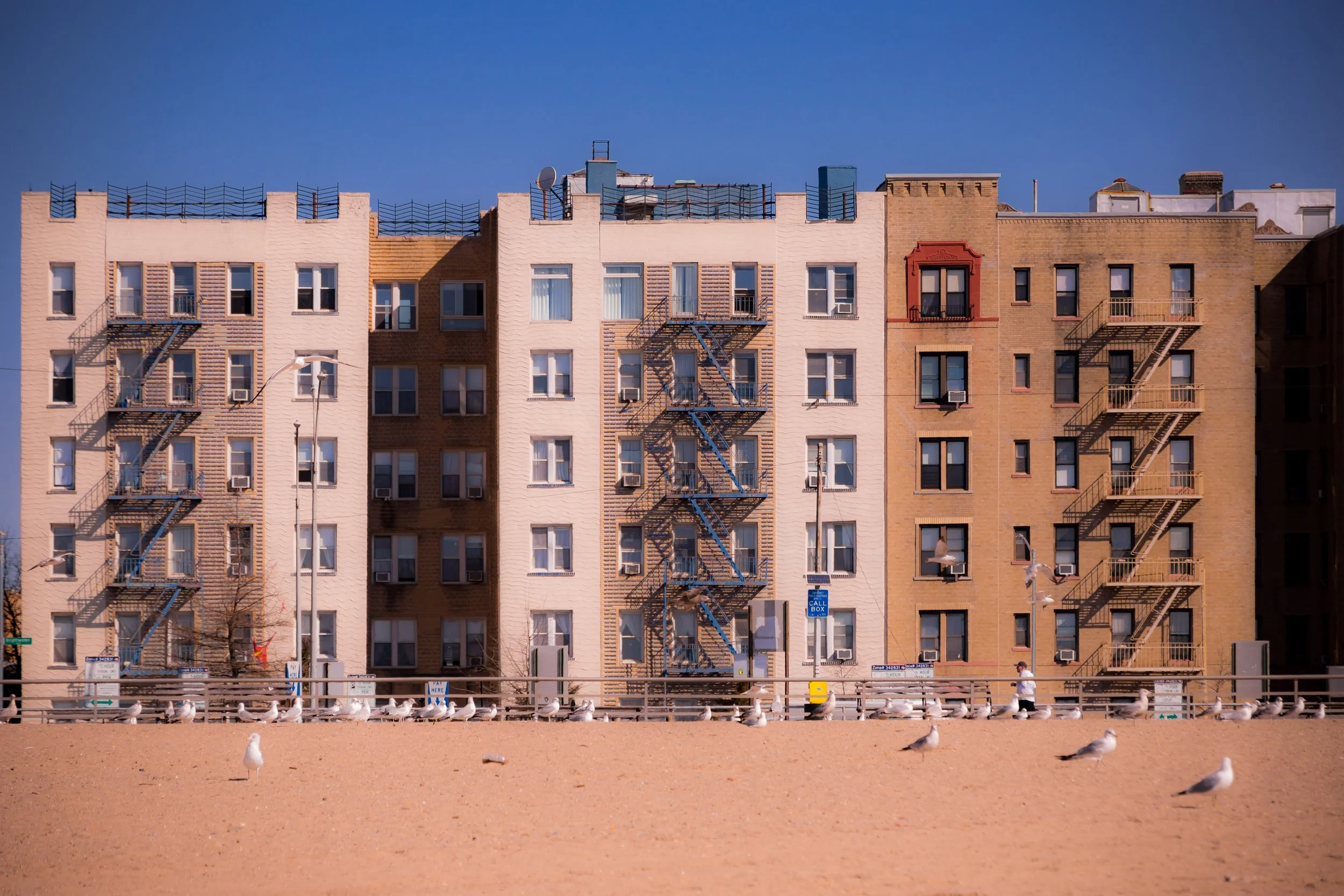
In the 1920s and 1930s, apartment buildings and art deco structures rose along Ocean Parkway and Brightwater Court, giving the neighborhood much of its current architectural character. Brighton Beach Avenue evolved into a lively commercial corridor—its open-air markets and kosher delis feeding both residents and visitors.
Brighton Beach Photographic Video
Postwar Era and the Russian Exodus
The most profound chapter in Brighton Beach’s modern history began in the 1970s, when large numbers of Soviet Jewish immigrants arrived, fleeing religious persecution and political repression. Drawn by affordable housing and the seaside environment reminiscent of Odessa and the Black Sea, they transformed Brighton Beach into a new kind of resort—a refuge of language, culture, and cuisine.
The streets filled with Russian signage, Cyrillic newspapers, and shops selling herring, caviar, black bread, and smoked fish. Brighton Beach Avenue became the unofficial main street of the Russian diaspora—nicknamed “Little Odessa by the Sea.” Nightclubs and cabarets hosted performers from across the former Soviet Union; bookstores sold Russian literature; and theaters staged plays in the language of Chekhov and Bulgakov.
Architecture and Streetscape
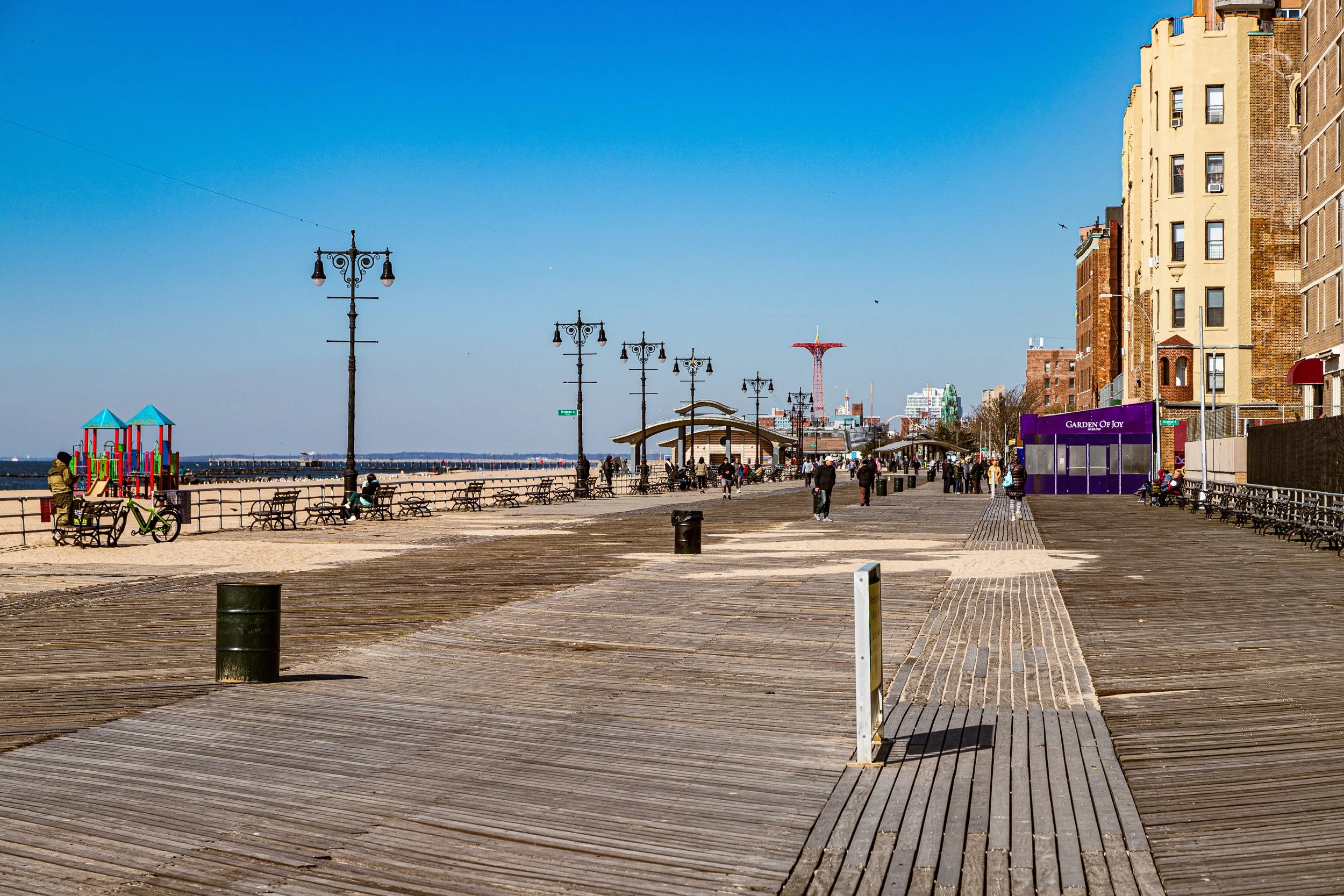
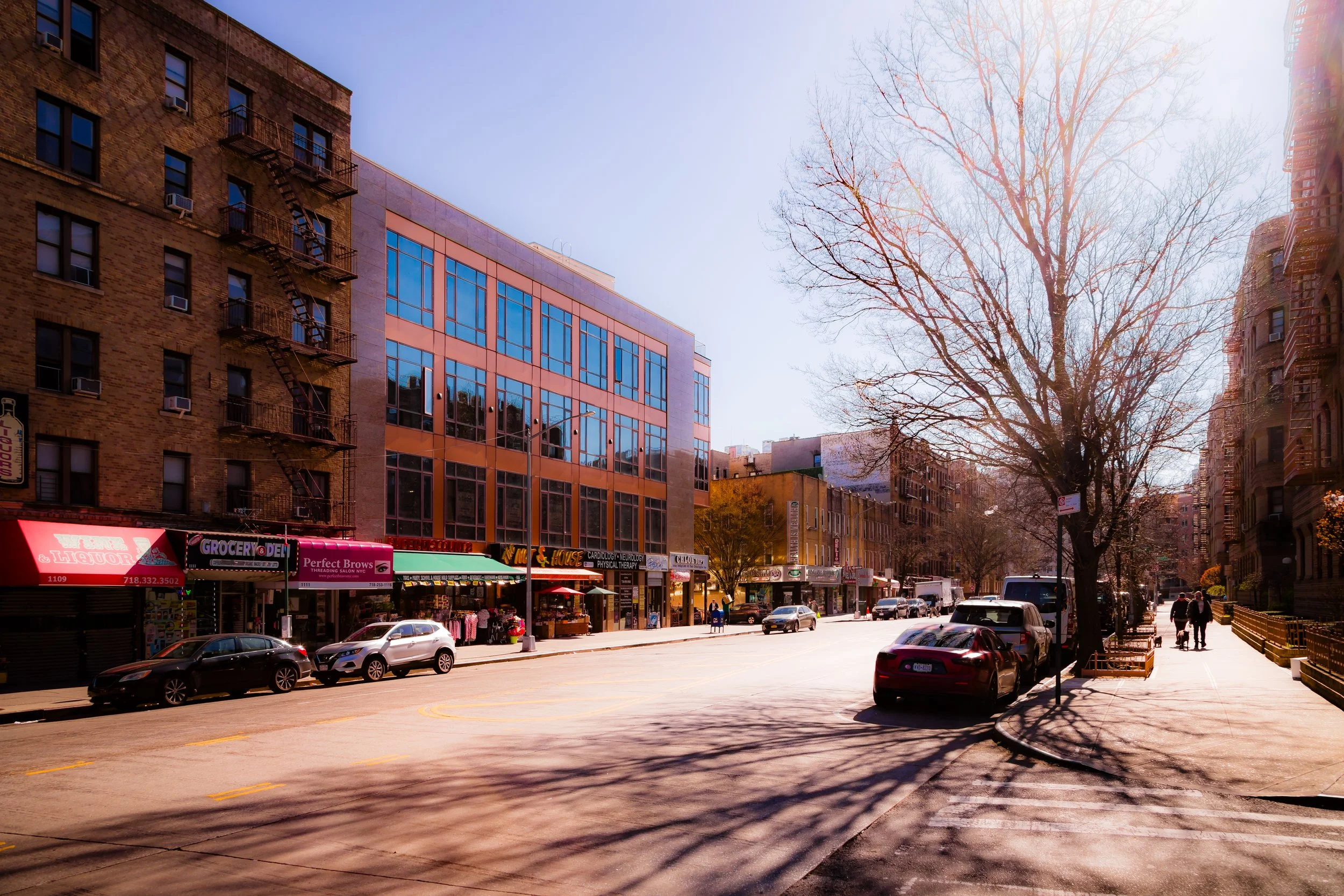
Brighton Beach’s built environment is a mixture of eras. The low-rise brick buildings of the early 20th century coexist with postwar apartment towers such as Brighton Towers and Trump Village, constructed in the 1960s as part of urban renewal. The elevated subway casts rhythmic shadows across the avenue, beneath which vendors sell fruit, fish, and pastries from sidewalk stalls. The Riegelmann Boardwalk, shared with neighboring Coney Island, remains the community’s front porch—a place where generations stroll, fish, and watch the sun set over the Atlantic.
Cultural Life and Continuity
Though shaped by waves of immigration, Brighton Beach retains a striking continuity of purpose: it is, and has always been, a place of escape. In summer, the beach hums with families picnicking under umbrellas and children chasing waves. Along the avenue, restaurants serve pelmeni, shashlik, and borscht beside neon-lit cafés where Russian pop songs play late into the night. English mingles with Russian and Ukrainian in the air, forming a polyglot chorus as familiar here as the sound of the ocean.
In recent years, the neighborhood has welcomed new immigrants from Central Asia, the Caucasus, and Latin America, adding further layers to its cosmopolitan identity. Yet the essence of Brighton Beach endures: an enclave defined by sea air, resilience, and memory.
Brighton Beach Photo Gallery
Spirit and Legacy
Brighton Beach is, at heart, a story of reinvention—of a place that has continually redefined itself while remaining true to its seaside spirit. From 19th-century resort to immigrant haven, it embodies Brooklyn’s eternal cycle of arrival and renewal.
New York City
Use this custom Google map to explore where every neighborhood in all five boroughs of New York City is located.
The Five Boroughs
One of New York City’s unique qualities is its organization in to 5 boroughs: Manhattan, Brooklyn, Queens, The Bronx, and Staten Island. These boroughs are part pragmatic administrative districts, and part vestiges of the region’s past. Each borough is an entire county in New York State - in fact, Brooklyn is, officially, Kings County, while Staten Island is, officially Richmond County. But that’s not the whole story …
Initially, New York City was located on the southern tip of Manhattan (now the Financial District) that was once the Dutch colony of New Amsterdam. Across the East River, another city was rising: Brooklyn. In time, the city planners realized that unification between the rapidly rising cities would create commercial and industrial opportunities - through streamlined administration of the region.
So powerful was the pull of unification between New York and Brooklyn that three more counties were pulled into the unification: The Bronx, Queens, and Staten Island. And on January 1, 1898, the City of New York unified two cities and three counties into one Greater City of New York - containing the five boroughs we know today.
But because each borough developed differently and distinctly until unification, their neighborhoods likewise uniquely developed. Today, there are nearly 390 neighborhoods, each with their own histories, cultures, cuisines, and personalities - and each with residents who are fiercely proud of their corner of The Big Apple.