
2ND AVENUE
Geographic Setting
Second Avenue runs north–south along Manhattan’s East Side, stretching from Houston Street in the East Village to Harlem River Drive at 128th Street, tracing a near-continuous line through some of the island’s most storied neighborhoods: the East Village, Kips Bay, Murray Hill, Turtle Bay, Midtown East, the Upper East Side, and East Harlem. Parallel to First Avenue and just west of the FDR Drive, the avenue forms part of the grid laid out by the Commissioners’ Plan of 1811, serving as one of Manhattan’s original longitudinal spines.
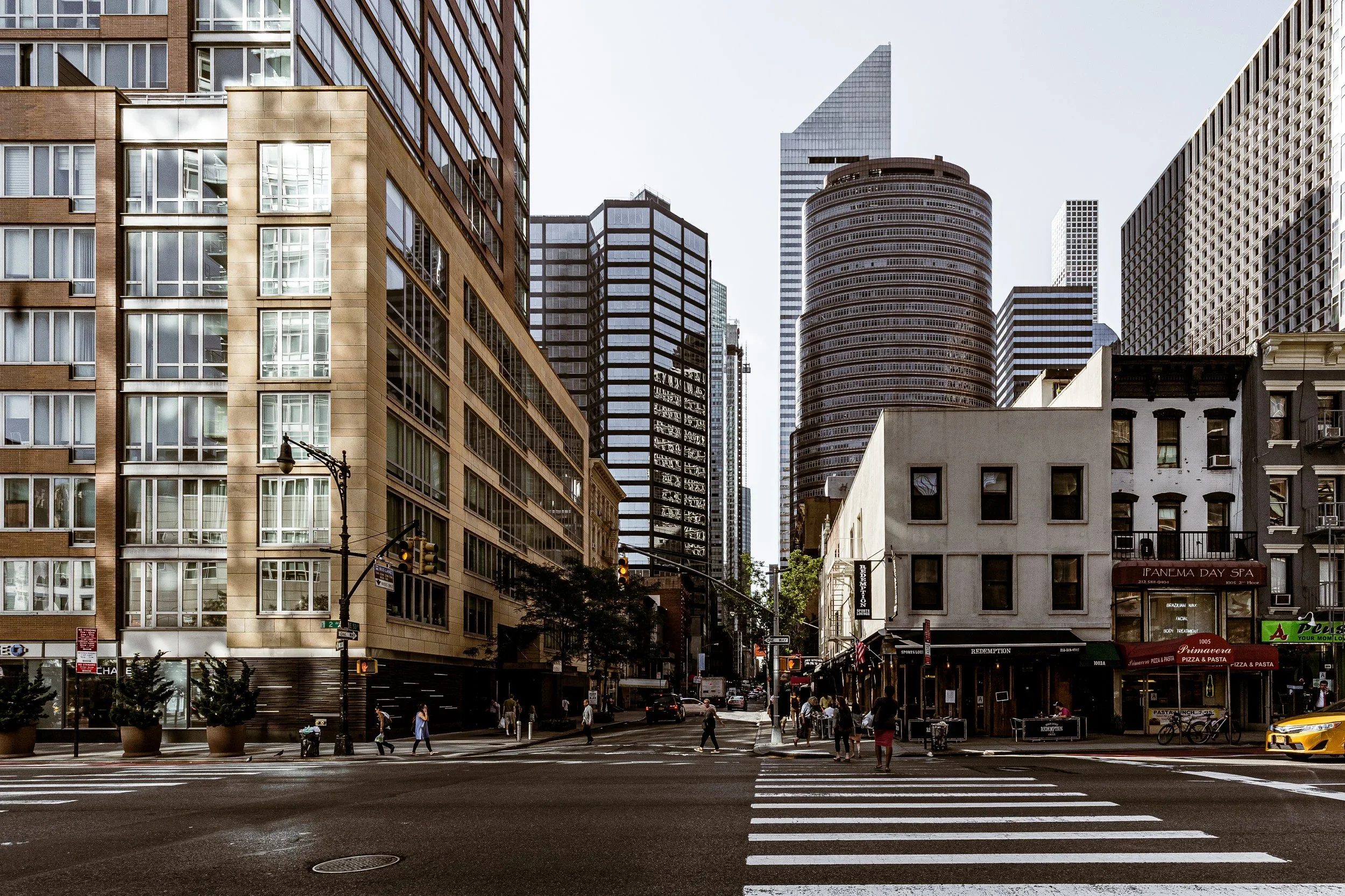
Its character changes like a time-lapse of the city itself. Downtown, Second Avenue is narrow, lively, and eclectic—lined with tenement-era walk-ups, Ukrainian diners, jazz bars, and tattoo parlors that speak to the East Village’s bohemian past. Midway through Midtown, it broadens beneath glass towers, office blocks, and residential high-rises. Uptown, it becomes quieter and more residential, shaded by elms and lined with prewar apartments and small shops, before climbing toward the elevated Second Avenue Subway, whose long-awaited opening in 2017 reconnected the avenue to a legacy interrupted nearly a century earlier.
Geographically, Second Avenue is the East Side’s central artery—a corridor of evolution where Manhattan’s social, architectural, and infrastructural history converge in continuous motion.
Etymology
Like its companion avenues, Second Avenue derives from the Commissioners’ Plan of 1811, which imposed a numbered order upon the island’s geography, creating a rational grid meant to guide its transformation from farmland to metropolis. The choice of numbers over names was deliberate: to convey order, equality, and clarity in a rapidly expanding city. Yet over time, Second Avenue developed a distinct identity of its own—shaped by the people and neighborhoods that made it their home.
For much of the 19th and 20th centuries, “Second Avenue” became synonymous not with the abstract order of a map, but with sound, struggle, and reinvention: the hum of the Second Avenue Elevated, the laughter and pathos of Yiddish theater, and the persistence of immigrant New York carving life out of concrete and steel.
The Avenue
Origins through the 19th Century: From Farmland to Immigrant Corridor
In the early 19th century, before the grid was fully realized, the stretch that would become Second Avenue ran through open farmland, estates, and salt meadows east of what was then the city’s settled core around the Bowery. Development began in earnest after 1820, as northward expansion filled the Lower East Side with working-class housing and small factories. Cobblestones and gas lamps replaced dirt paths; horse-drawn omnibuses connected downtown to the growing communities near 23rd Street.
By mid-century, Second Avenue had become the principal axis of the East Side’s immigrant life. Tenements rose in the wake of mass migration from Ireland and Germany, later joined by Eastern European Jews, Italians, and others who transformed the Lower East Side into a mosaic of cultures. The avenue teemed with shops, beer halls, tailors, and synagogues—each block an ecosystem of labor and language.
In the 1870s, the construction of the Second Avenue Elevated Railway brought even more vitality. Steel tracks and wooden platforms rose above the avenue, carrying trains from South Ferry north to Harlem. The “El,” as it was known, connected working-class residents to jobs across the island and linked neighborhoods that were previously isolated. Its thunder and shadow defined the avenue’s sensory world for the next 70 years.
North of 42nd Street, the avenue retained a semi-rural character longer. Kips Bay and Turtle Bay remained scattered with stables and modest houses, while the future Midtown East was still dominated by breweries, slaughterhouses, and warehouses near the East River. Only in the late 19th century did speculative builders begin filling these blocks with brownstones and tenements, extending the avenue’s working-class pulse uptown.
Early 20th Century: Yiddish Broadway and the Roar of the El
By the turn of the 20th century, Second Avenue had entered its cultural zenith. Between Houston Street and 14th Street, the avenue became known as “Yiddish Broadway”—the heart of Jewish New York’s theatrical scene. Dozens of playhouses, cafés, and music halls lined the avenue, from the Yiddish Art Theatre at 12th Street to the Second Avenue Theatre at 2nd Street. Stars like Jacob Adler, Molly Picon, and Boris Thomashefsky filled the seats, performing dramas and comedies that blended Old World traditions with New World themes.
The avenue’s nightlife was legendary: crowded sidewalks, electric marquees, and the aromas of borscht, knishes, and cigars wafting from packed restaurants. It was a world both self-contained and universal—a place where immigrants saw their lives reflected on stage, and where the cultural DNA of American entertainment began to form.
Meanwhile, the Second Avenue Elevated loomed overhead, its girders casting long shadows by day and glittering with light by night. The El was both a lifeline and a nuisance—vital for commuting but deafeningly loud, its rumble shaking tenement windows and drowning out conversation. Yet the sound of the El became the soundtrack of life along the East Side, symbolizing both motion and endurance.
Farther uptown, between 34th and 59th Streets, the avenue took on a more industrial and institutional character, lined with breweries, factories, and hospitals. The opening of Bellevue Hospital’s new pavilion (1902) and the expansion of the NYU Medical College anchored the area as the city’s medical corridor. The avenue thus embodied two faces of the metropolis: culture and care, laughter and labor.
Mid–Late 20th Century: Demolition, Decline, and Renewal
The postwar decades brought upheaval. The Second Avenue Elevated, obsolete and noisy, was demolished in 1942–1955, dismantling an infrastructure that had defined the neighborhood for generations. In its absence, property values initially fell, and businesses that had depended on commuter traffic struggled. The promised replacement—the Second Avenue Subway—was announced as early as 1929, but construction was repeatedly delayed by fiscal crises and shifting priorities, leaving the avenue without rapid transit for decades.
At the same time, urban renewal projects reshaped the East Side. The construction of Stuyvesant Town and Peter Cooper Village (1945–1949) replaced entire blocks of tenements between First and Second Avenues with modern brick towers and landscaped courtyards. While the development offered improved living conditions for thousands, it also displaced long-established working-class communities.
Further north, Murray Hill and Turtle Bay evolved into middle-class residential districts, while the rise of the United Nations Headquarters (completed 1952) along First Avenue transformed the surrounding area into an international zone of diplomats and office towers. Second Avenue became a service corridor—lined with dry cleaners, diners, and small markets catering to residents rather than industry.
By the 1970s and 1980s, the avenue’s lower reaches—particularly in the East Village—were at the center of the city’s countercultural transformation. Former Yiddish theaters became punk clubs, performance spaces, and experimental art venues. Second Avenue was home to icons like CBGB’s nearby on the Bowery, avant-garde artists in lofts, and generations of activists who reshaped urban life from the ground up. Uptown, the avenue’s Upper East Side segment—long more sedate—became a dining corridor of Italian restaurants, neighborhood bars, and small boutiques.
21st Century: The Long-Awaited Subway and the Avenue Reborn
The 21st century brought long-delayed fulfillment. After nearly a century of promises, the Second Avenue Subway finally opened its first phase in January 2017, serving the Upper East Side with new stations at 72nd, 86th, and 96th Streets. This modern underground line restored Second Avenue’s role as a major transit corridor and spurred a wave of revitalization along its northern reaches.
In the East Village, the avenue has gentrified while retaining pockets of its old character—Ukrainian restaurants like Veselka, Jewish delis, and century-old bars stand beside chic cafés, vintage stores, and yoga studios. The avenue now hums with students, artists, and young professionals, but remnants of its immigrant roots linger in the façades and signage of earlier eras.
Midtown East remains an area of transition—defined by sleek residential towers rising alongside postwar co-ops and small shops. On the Upper East Side, the new subway line has invigorated retail and dining, while improved sidewalks and bike lanes have made the avenue more pedestrian-friendly. In East Harlem, where the avenue narrows and the grid bends, the landscape shifts again: bodegas, churches, and taquerías mark a neighborhood in flux yet rich in cultural continuity.
Second Avenue today is a cross-section of modern Manhattan—residential yet restless, cosmopolitan yet local. It is a space of movement, both literal and historical, where each block reveals another chapter in the city’s ongoing reinvention.
Spirit and Legacy
The spirit of Second Avenue is resilience. It has endured fire, noise, demolition, and decades of deferred promise, only to emerge again and again in new form. Its story is that of the East Side itself—immigrant arrival, cultural flowering, urban transformation, and eventual renewal.
The avenue’s legacy is written in sound and survival: the rumble of the old El, the laughter of Yiddish theater crowds, the clang of dishes in diners that have never closed, the quiet glide of the new subway beneath. It has been a stage for aspiration and a refuge for the ordinary—proof that the city’s pulse runs strongest not in monuments, but in the daily life of its streets.
New York City
Use this custom Google map to explore where every neighborhood in all five boroughs of New York City is located.
The Five Boroughs
One of New York City’s unique qualities is its organization in to 5 boroughs: Manhattan, Brooklyn, Queens, The Bronx, and Staten Island. These boroughs are part pragmatic administrative districts, and part vestiges of the region’s past. Each borough is an entire county in New York State - in fact, Brooklyn is, officially, Kings County, while Staten Island is, officially Richmond County. But that’s not the whole story …
Initially, New York City was located on the southern tip of Manhattan (now the Financial District) that was once the Dutch colony of New Amsterdam. Across the East River, another city was rising: Brooklyn. In time, the city planners realized that unification between the rapidly rising cities would create commercial and industrial opportunities - through streamlined administration of the region.
So powerful was the pull of unification between New York and Brooklyn that three more counties were pulled into the unification: The Bronx, Queens, and Staten Island. And on January 1, 1898, the City of New York unified two cities and three counties into one Greater City of New York - containing the five boroughs we know today.
But because each borough developed differently and distinctly until unification, their neighborhoods likewise uniquely developed. Today, there are nearly 390 neighborhoods, each with their own histories, cultures, cuisines, and personalities - and each with residents who are fiercely proud of their corner of The Big Apple.